Research on the six economies of the Gulf Cooperation Council
Category: The Arabian Gulf
The Gulf Cooperation Council (GCC) is a regional, intergovernmental, political, and economic union made up of Bahrain, Kuwait, Oman, Qatar, Saudi Arabia, and the United Arab Emirates (UAE) and came into being after signing a joint charted on the 25th of May, 1981. The GCC, not surprisingly, is headquartered in the Saudi capital, Riyadh. Saudi Arabia is by far the most populous of the six Arabian Gulf states. These six countries have long been viewed analytically as broadly similar to one another and were once labelled by the World Bank as being “resource-rich [but] labour poor.”
I have updated the Arabian Gulf datasets page. The Tables, Charts and accompanying notes I’ve added there, resulted from the research I undertook whilst writing a short piece for The Conversation, titled, “The Middle East conflict has swiftly exposed economic vulnerability in the region” and filed here as, “Epically Furious.”
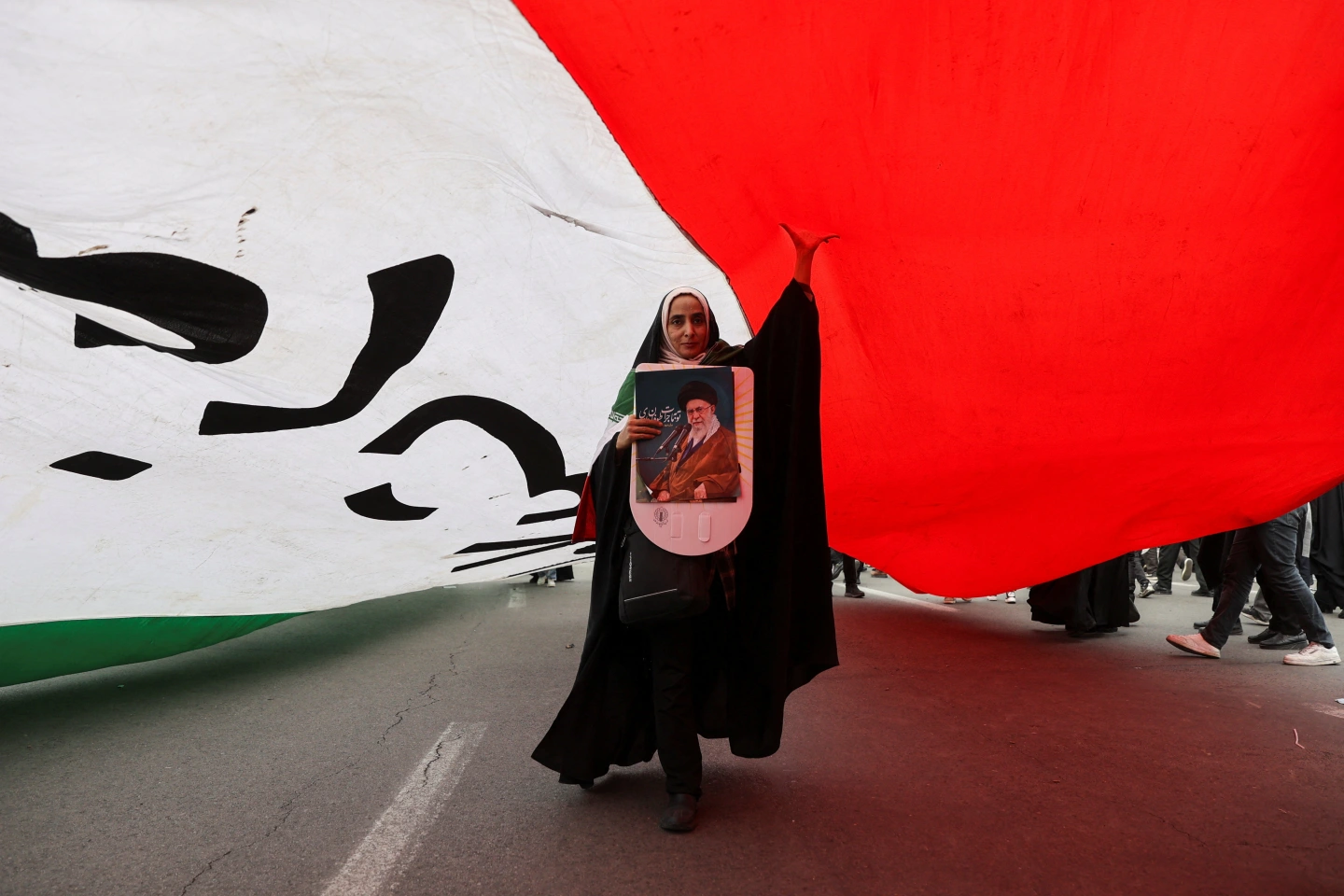
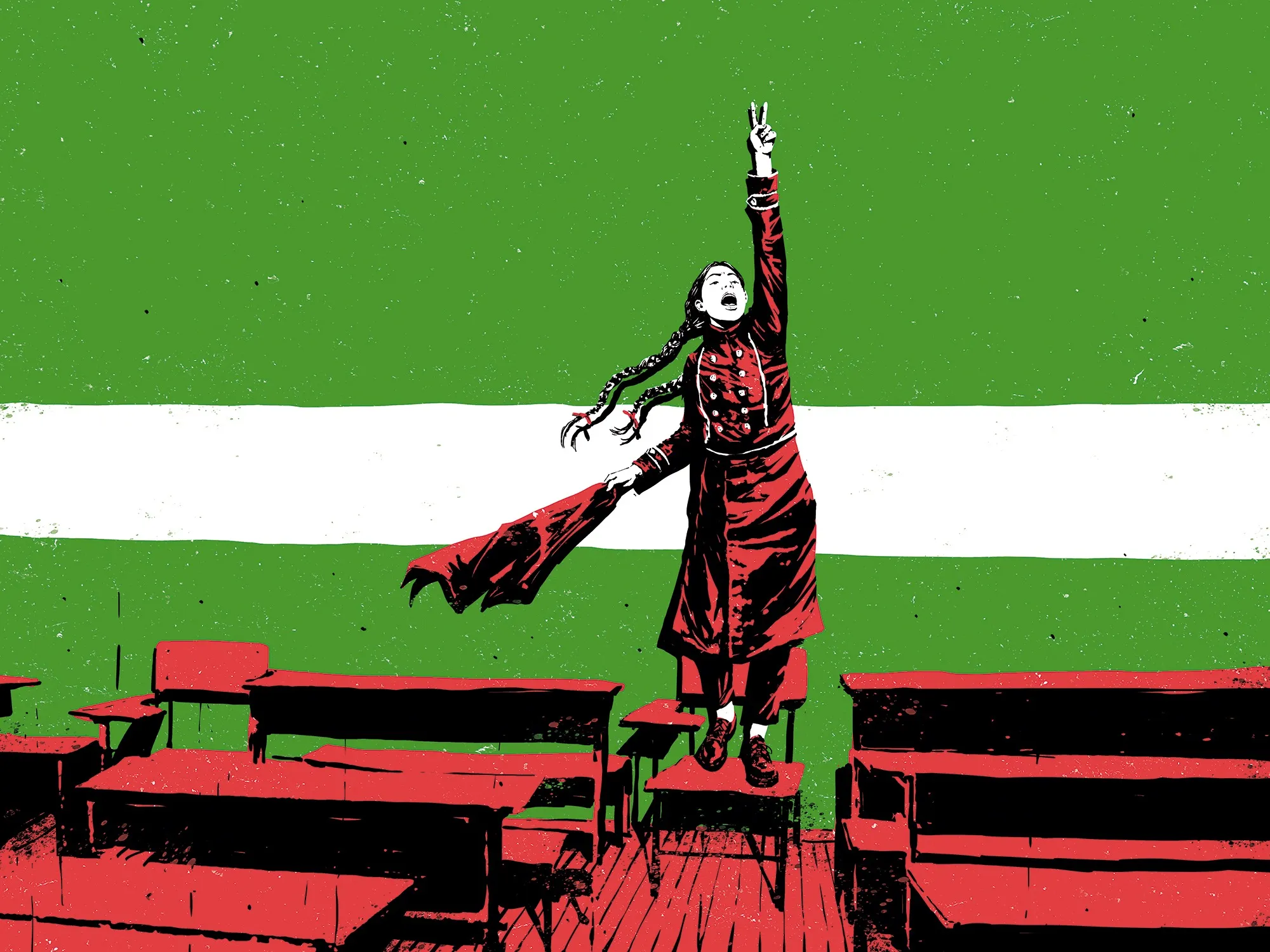
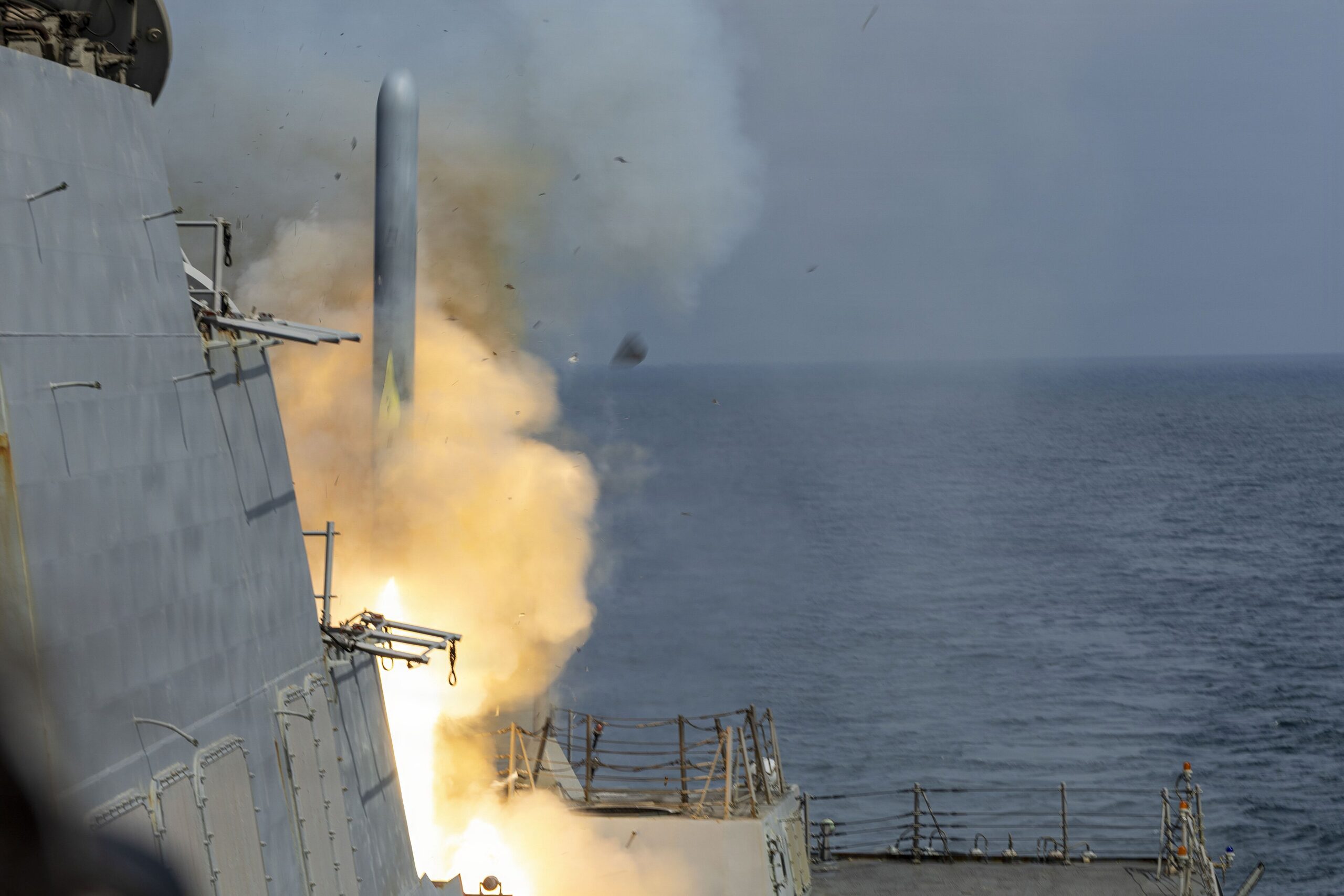
An Iranian woman holding a poster depicting Iran’s Supreme Leader Ayatollah Ali Khamenei walks under a large flag during the 47th anniversary of Iran’s Islamic Revolution, on February 11, 2026 (a Majid Asgaripour/West Asia News Agency photo).Iranian school-aged girl depicted (an Adams Carvalho illustration).Arleigh Burke-class guided-missile destroyer “USS Delbert D. Black” fires a Tomahawk attack missile in support of operation “Epic Fury,” February 28, 2026 (a U.S. Navy photo).
Tomahawk attack
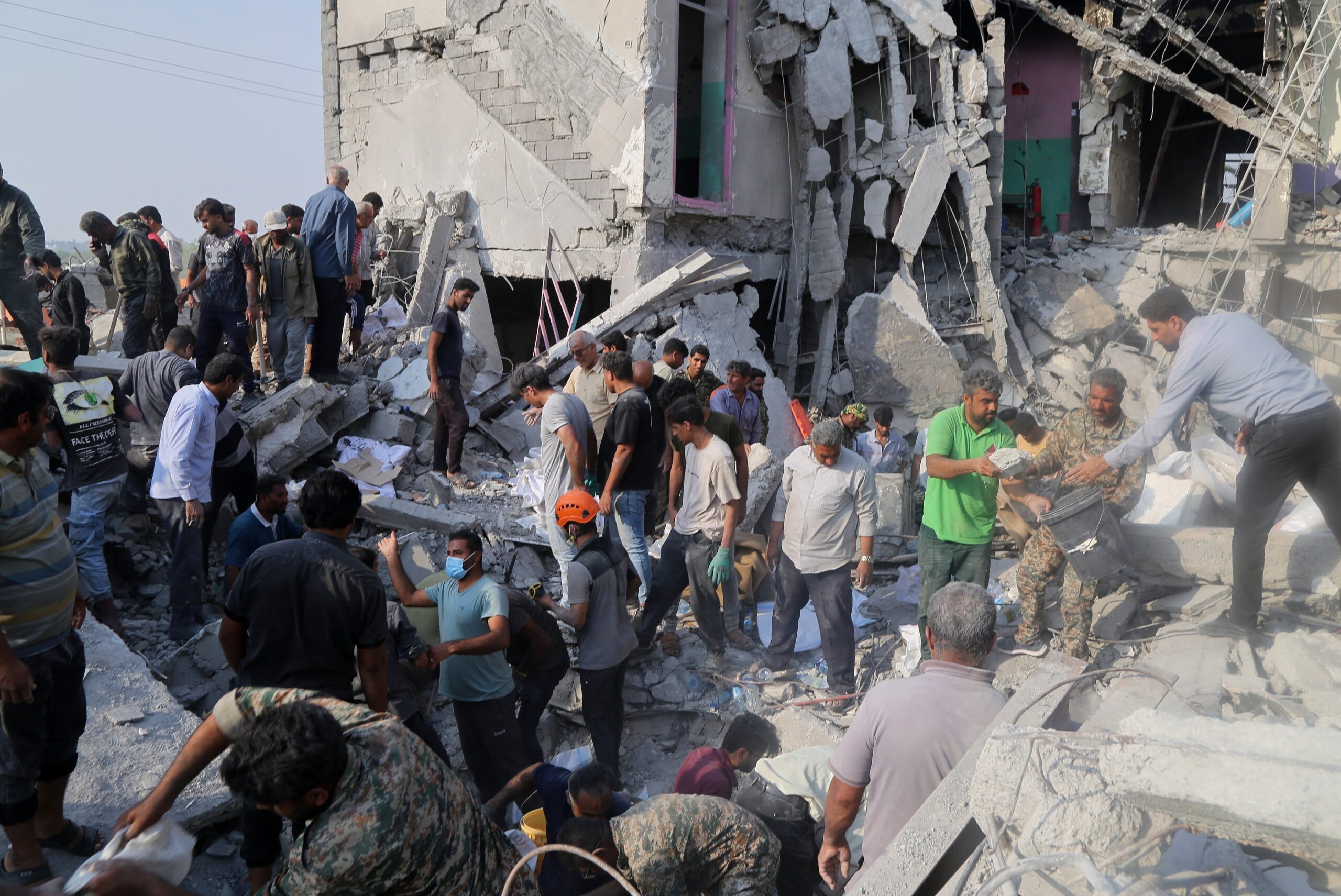
Regarding the 2026 Minab school attack, this is what we do know: on 28 February 2026, the first day of the America and Israel’s war on Iran, the Shajareh Tayyebeh girls’ elementary school in Minab (southern Iran) was destroyed by a missile attack/strike (words matter, take your pick). Iranian authorities told the New York Times that the attack killed at least 175 people, including scores of civilians. Human Rights Watch reviewed lists with dozens of names of children and adults reportedly killed in the attack, and was able to immediately match some names with ages and other identifying information on body bags and caskets.
Shajareh Tayyebeh school in Minab, Iran, February 28, 2026 (a Abbas Zakeri/Mehr News Agency photo).
The New York Timesreported that the investigation found that the attack was the result of a targeting mistake by the US military, which was carrying out strikes on an Islamic Revolutionary Guard Corps naval base of which the school building had previously been a part. The report said that US Central Command officers created the target coordinates for the strike using outdated data provided by the US Defense Intelligence Agency.
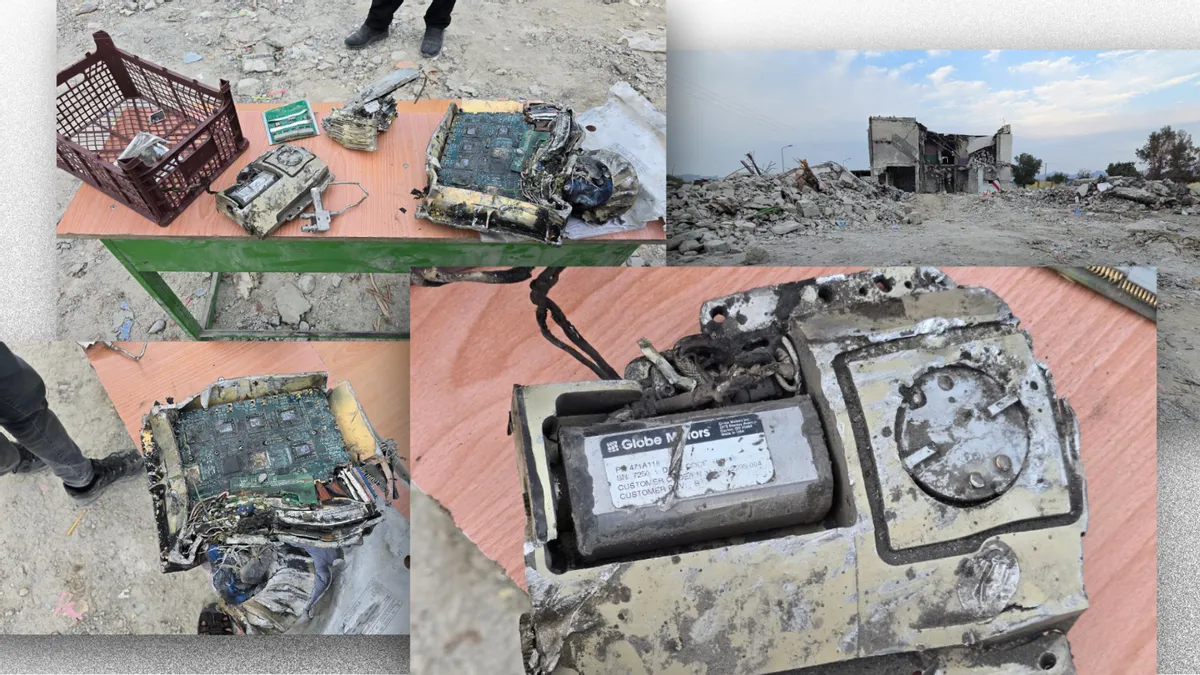
A compilation of images showing fragments of an American made missile and the bombed Iranian girls’ school in Minab (an IRIB photo).
Four avenues of investigation regarding the Tomahawk attack on Minab Girls School are provided here (the fourth has great satellite imagery of the site):
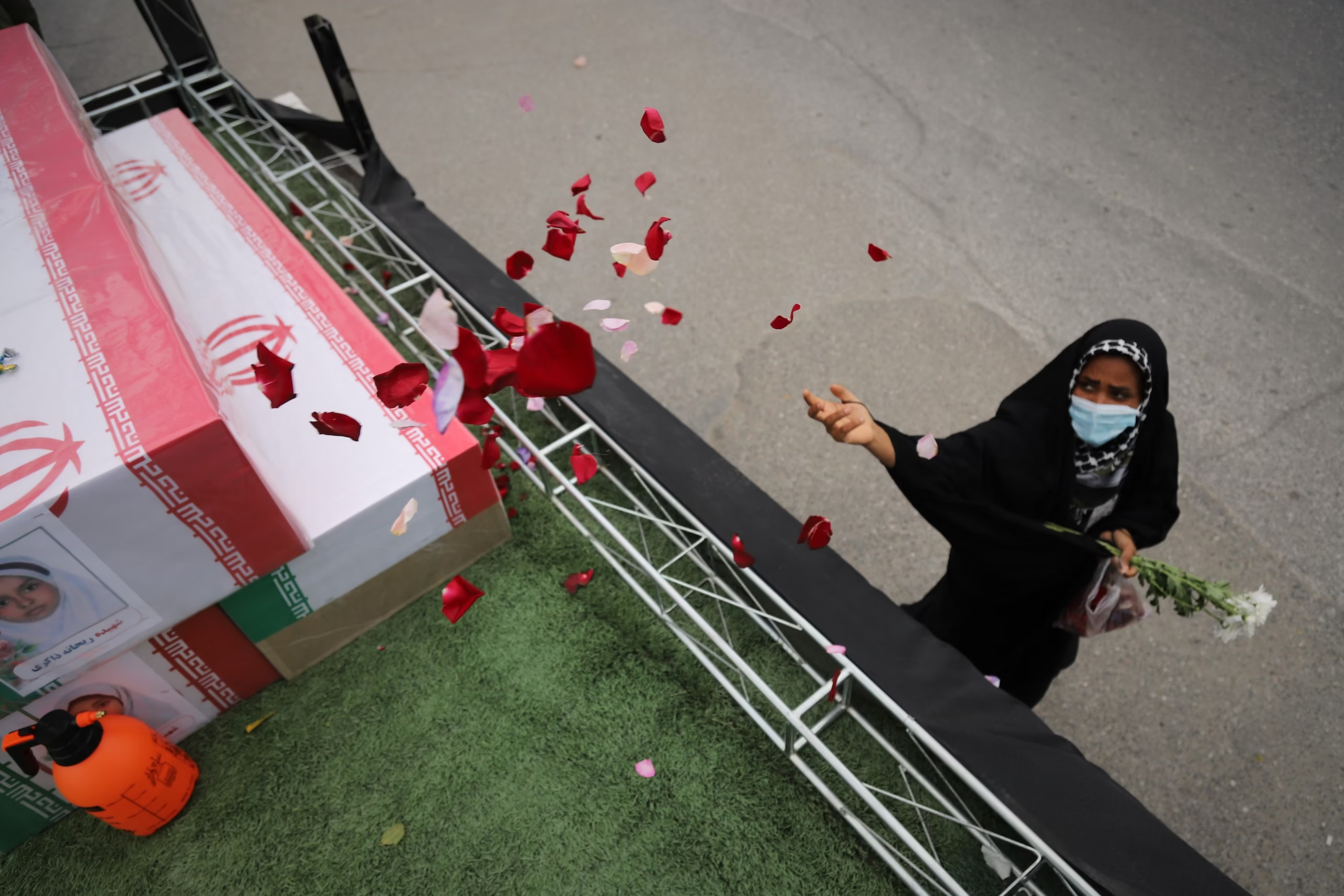
Graves being dug for children killed in deadly strike school in Minab (an Iranian Press Center/AFP photo).Poignant Petals (an Amirhossein Khorgooei/AP photo).
It is hard not to conclude that Iran was blatantly betrayed twice by the U.S. administration.
Betrayal 1
Oman and Tehran were fooled once back in June of 2025.
Betrayal 2
In a laudable and concerted effort not to be fooled for a second time, on February 27th Oman’s Foreign Minister, Badr Albusaidi, got on a plane and flew all the way to Washington D.C. and immediately went on to CBS’s flagship “Face The Nation” program to tell the American public directly that the concessions Iran had just offered to give to Trump were game changing and (Iranian) regime saving. Albusaidi—on behalf, I would ague, of all GCC countries—was doing his utmost to ensure that conflict would not break out, at least not over that weekend. After all, could he categorically guarantee that Messrs Kushner and Witkoff (Trump’s self-appointed diplomatic duo) would not possibly forgot to convey the message to the American people themselves? I would argue too that the Iranians themselves genuinely believed that the seismic concession that they’d just offered was enough to have at least forestalled any prospect of war braking out that weekend. If they had not genuinely believed this, there is no way that Ayatollah Ali Khamenei would have been where he was that morning with both his key advisors and members of his nuclear family around him—his primary residence in the heart of Tehran in broad, early Spring, morning daylight.
Betrayal 3
This I argue (here and elsewhere) is America’s betrayal of the long loyal oil-rich Arabian Gulf countries.
I am certain that the Gulf countries themselves will not have been happy that despite all their protestations — both on TV and behind closed doors — the Americans went ahead and for a second time attacked Iran without warning and without imminent threat. The special relationships that the leaders of Saudi Arabia, Qatar and the UAE had forged with Trump—furnished and oiled so-to-speak, with staggeringly large investment into America and the purchasing of U.S.-made military industrial equipment deals—appeared to have no influence on Trump’s decision to subject the region to another purpose-wise, ill defined war. The betrayal (of trust, friendship) was all the greater to the GCC countries because over the past decades they had spent billions upon billions on American armaments, withstood some domestic disquiet in offering to host and mostly cover the costs of American military bases on all six of their territories and indeed, a few of this countries had even signed up to Trump and Kushner’s Abraham Accords. The Gulf countries are right to feel aggrieved as the “safe haven” they had worked so hard to achieve was partly underwritten on the assumption that having an American presence in the background on their soil and at their ports, would prevent not provoke attacks.
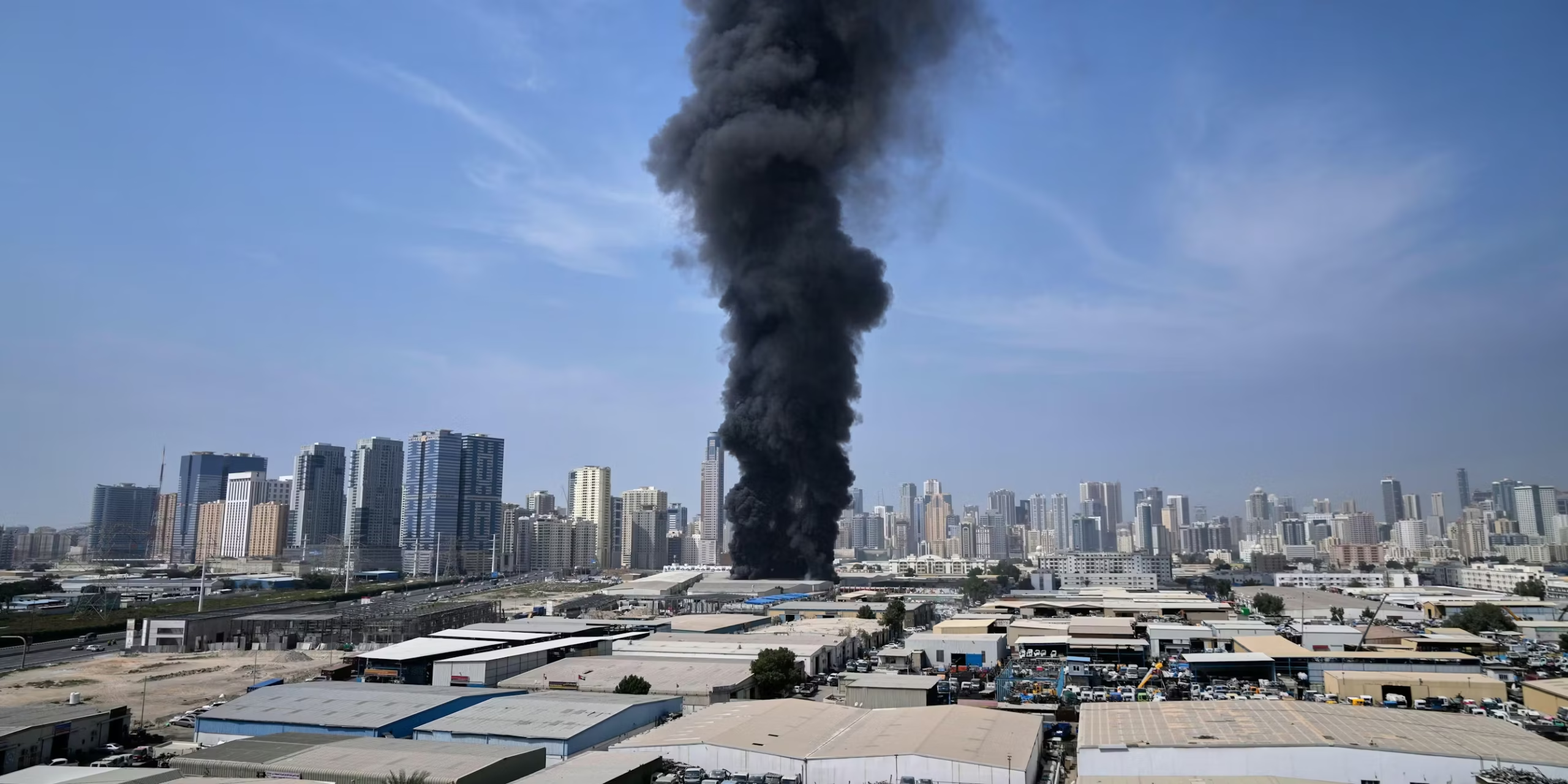
Smoke rises from Sharjah City in the United Arab Emirates (an Altaf Qadri/AP photo).
At the end of 2025, the Gulf states received high praise for their economic resilience. According to reports by the World Bank and the World Economic Forum, the region was stable, modern and reliable.
Now the six countries of the Gulf Cooperation Council (GCC) – Bahrain, Kuwait, Oman, Qatar, Saudi Arabia and the United Arab Emirates – are watching on nervously. The economic damage done by what has become a regional conflict, bringing an abrupt loss of stability, could be huge.
Aside from Saddam Hussein’s foray into Kuwait in 1991, these six countries have successfully steered clear of conflict on their home turf over a long period. They avoided the revolutionary upheavals which affected Egypt (1952), Iraq, Syria and Iran (1979). They steered clear of any spillover from the long-running Israel-Palestine conflict.
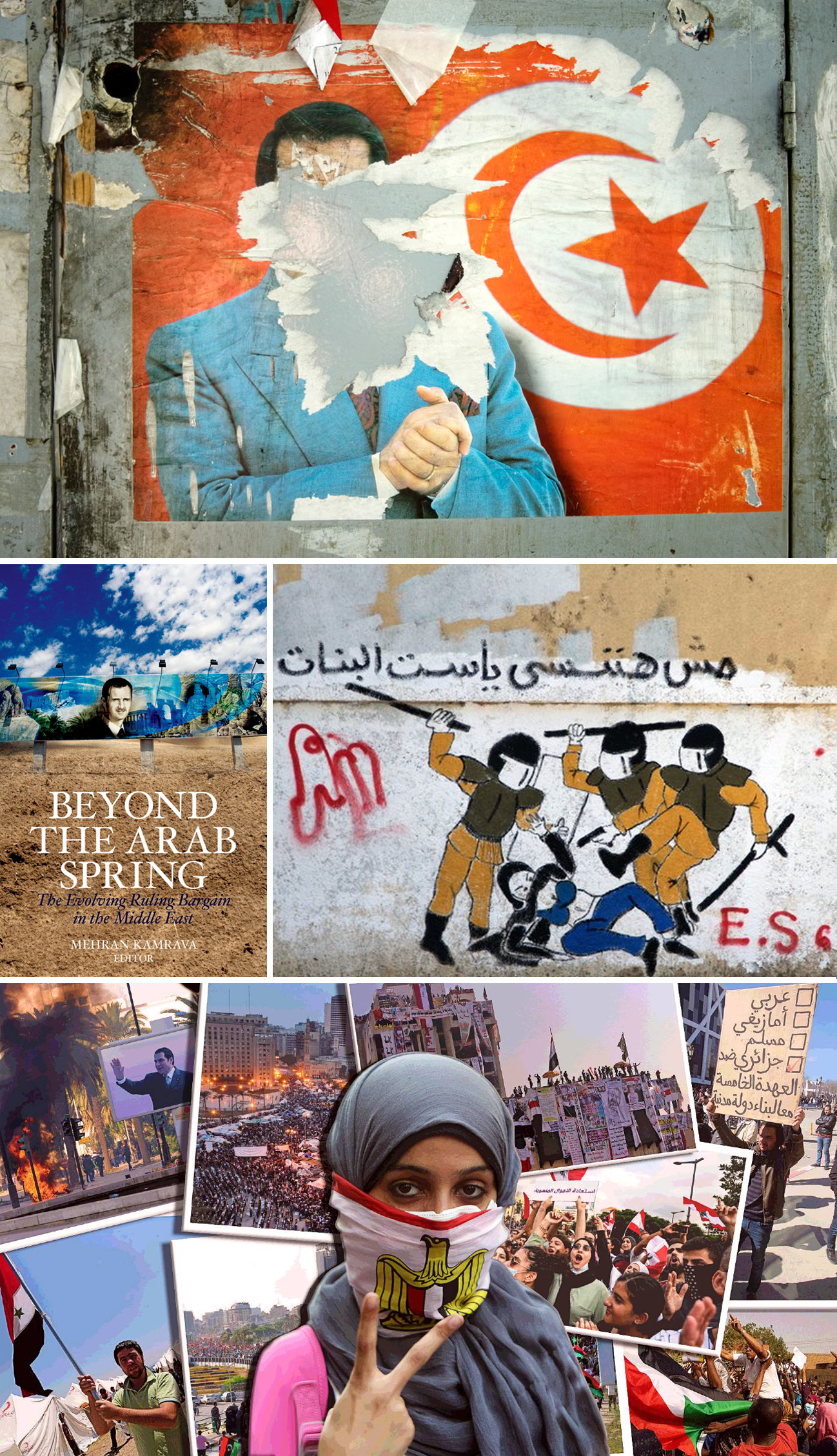
The group was mostly unaffected by the war between Iran and Iraq. And aside from a short-lived uprising in Bahrain in 2011, the GCC emerged largely unscathed from the regional turmoil of the Arab Spring in 2010 which spread from Tunisia and and Egypt and led to violent instability which continues to this day in Libya, Yemen and Syria.
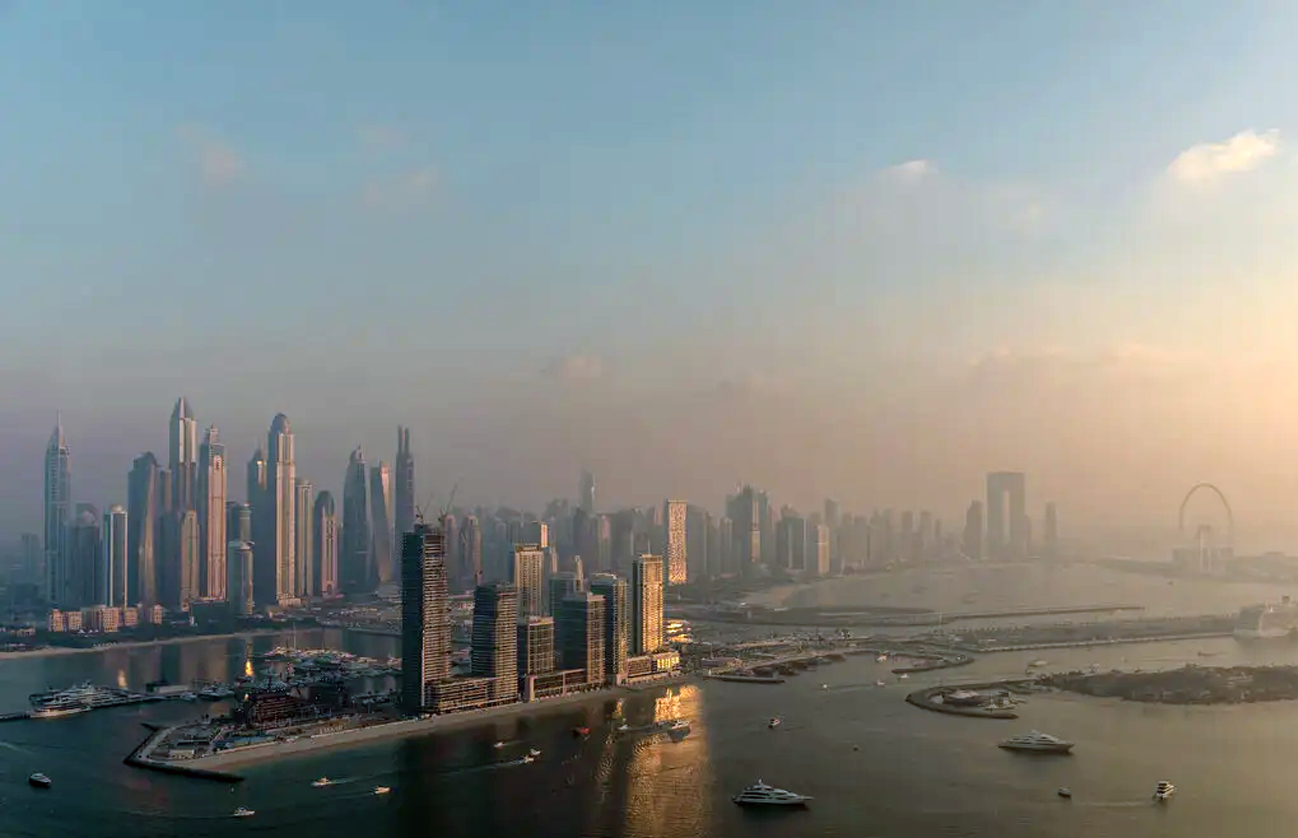
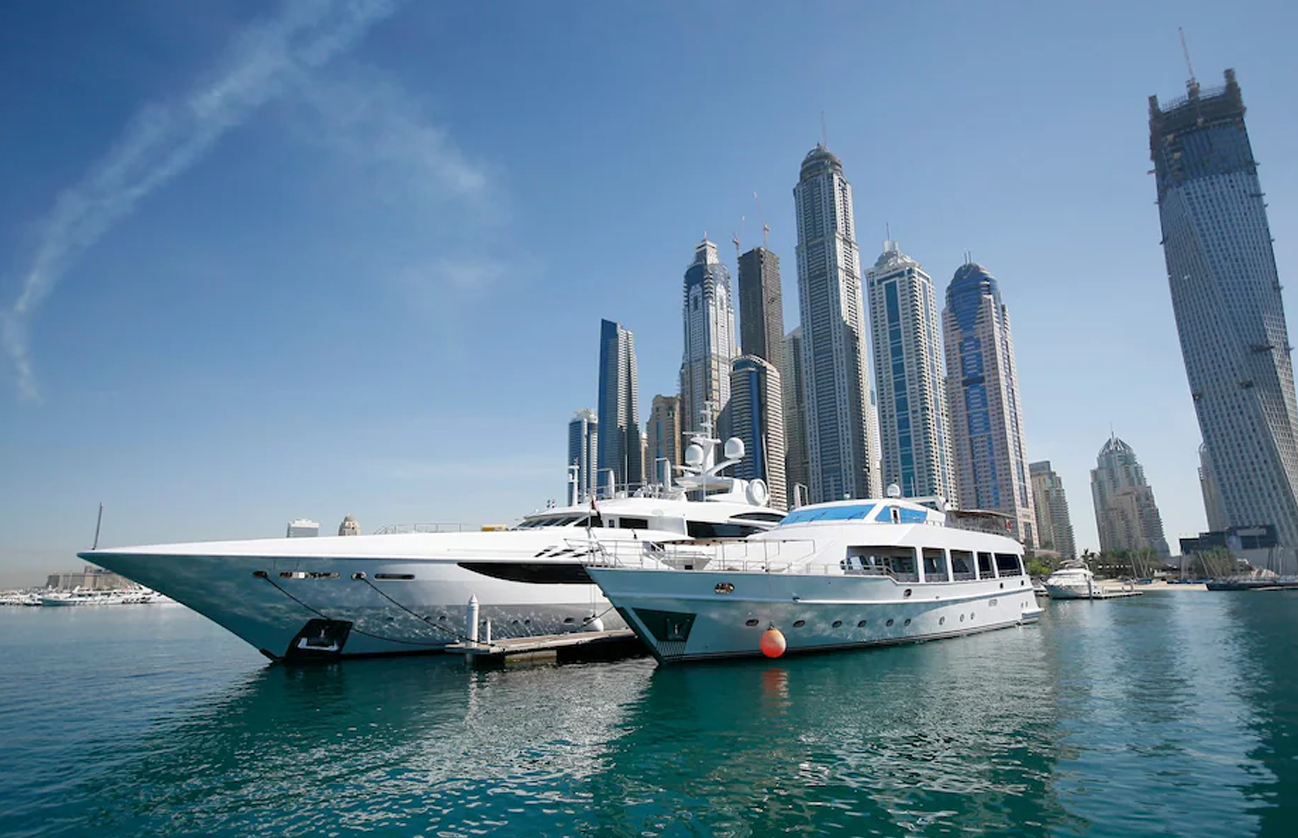
The GCC’s comparative stability underpins its attractiveness as a global hub for money and modernity. Success in luxury tourism has filled places such as Dubai and Abu Dhabi with five (and even a seven) star hotels. Only France has more Michelin-starred restaurants than the United Arab Emirates (UAE). There is cutting-edge technology in Qatar’s energy sector, and a vast AI campus in the UAE.
It is these kinds of projects which led the World Bank and the World Economic Forum to publish glowing reports on the region recently. Both organisations agreed in late 2025 that oil wealth was being wisely invested for the future.
The general view was that the GCC was a place of economic stability and diversity. A director of the World Bank, Safaa El Kogali, said that the region’s embrace of a digital future had been nothing short of “remarkable”.
Missiles from Iran directly hit three Amazon web service facilities, one in Bahrain and two in the UAE, leading the company to recommend that GCC businesses back up their data and migrate it to data centres in the US.
Despite efforts to diversify economies away from oil, for now the region is still clearly dependent on oil exports and food imports, hence the worries over Hormuz. There are fears for its numerous desalination plants, which provide drinking water (as well as filling infinity pools and keeping golf courses green).
And its status as a safe and sunny sanctuary for conference conveners, influencers, holiday makers and owners of second homes is now being questioned.
Even if the conflict were to end soon, reputational damage has been done. People are fleeing the area, as images of smoke filled skies fill screens.
This will inevitably dampen foreign direct investment in the immediate future. The course and duration of the conflict will determine the degree to which the region can bounce back and continue to attract holidaymakers and young professionals and those seeking a life with more sun and less tax.
From a geopolitical perspective, the region’s recent success – aside from its vast and easily extracted natural resources – has rested largely on the assumed political stability that was underwritten by hosting US military bases and buying US military hardware. Both of these could now prove to be an economic liability.
In 2018, The Economist explained the following in a piece with the following bi-line “An oasis for the tax-averse beckons in the Middle East”
More than 100 countries have signed up to the Common Reporting Standard (CRS), which requires them to swap information on account-holders that may be relevant for tax purposes. But the enterprising and tax-shy can still exploit loopholes in the system. A popular one is to procure residence in the United Arab Emirates (UAE), set up a company there and use the tax residence that comes with it to block the flow of information to tax authorities elsewhere. … Under the CRS (which is managed by the Organisation for Economic Co-operation and Development), banks must share information with the country where an account-holder is tax-resident. If the account holder is an entity, then the bank must look through it to the “controlling person” and report on that individual. In the UAE, since both the individual and the company have local tax residence, neither need fear having any information passed on to other countries, regardless of whether their money is held in a bank account, a trust or an investment fund.
Add to this that the UAE is largely tax-free and is likely to have to remain ‘mostly’ tax-free to retain its advantage over Saudi Arabia.
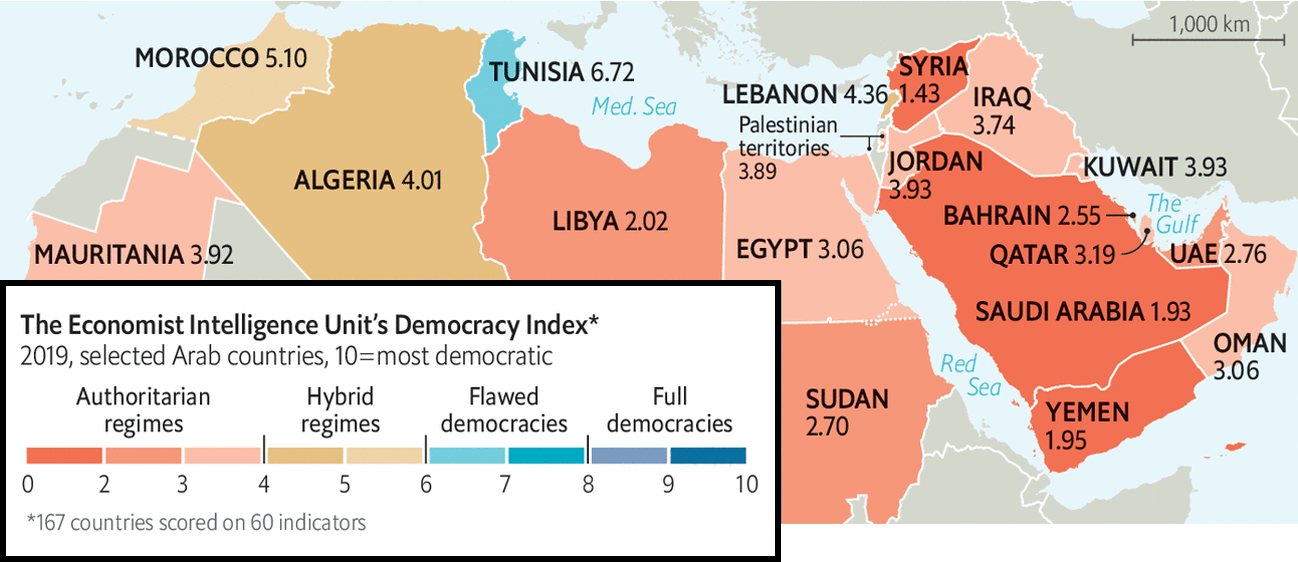
As Kamrava (2012) wrote, across the Arabian Gulf “an authoritarian retrenchment and narrowing of political space has emerged.” This reassertion of the state’s dictatorial authority has, of course, taken different forms across the region depending on the state’s overall societal posture. In Qatar, for example, where anti-state sentiments are conspicuous in their absence, there have not been any discernible changes in the domestic political environment. In the UAE, however, the space provided to civil society organisations has been steadily narrowed by the state since the beginning of the regional unrest. In Bahrain and Saudi Arabia, repression was notably more draconian still.
Abouzzohour (2021) ponders what are the implications of the fact that no monarch was overthrown during or since the Arab Spring. Various experts have linked the latter to monarchs’ legitimacy, external support, and resource wealth. She suggests that while there is no consensus view, “it is clear that monarchs have repeatedly and successfully contained different types of opposition threats for decades prior to the Arab Spring and continue to do so 10 years later.”
The “Arab Spring”The Economist (2020). Expand map.
Ten years on from the “Arab Spring” The Economist (2020) write:
“What kind of repression do you imagine it takes for a young man to do this?” So asked Leila Bouazizi after her brother, Muhammad, set himself on fire ten years ago. Local officials in Tunisia had confiscated his fruit cart, ostensibly because he did not have a permit but really because they wanted to extort money from him. It was the final indignity for the young man. “How do you expect me to make a living?” he shouted before dousing himself with petrol in front of the governor’s office. His actions would resonate across the region, where millions of others had reached breaking-point, too. Their rage against oppressive leaders and corrupt states came bursting forth as the Arab spring. Uprisings toppled the dictators of four countries—Egypt, Libya, Tunisia and Yemen. For a moment it seemed as if democracy had arrived in the Arab world at last. … Only one of those democratic experiments yielded a durable result—fittingly, in Bouazizi’s Tunisia. Egypt’s failed miserably, ending in a military coup. Libya, Yemen and, worst of all, Syria descended into bloody civil wars that drew in foreign powers. The Arab spring turned to bitter winter so quickly that many people now despair of the region. Much has changed there since, but not for the better. The Arab world’s despots are far from secure. With oil prices low, even petro-potentates can no longer afford to buy their subjects off with fat subsidies and cushy government jobs. Many leaders have grown more paranoid and oppressive. Muhammad bin Salman of Saudi Arabia locks up his own relatives. Egypt’s Abdel-Fattah al-Sisi has stifled the press and crushed civil society. One lesson autocrats learned from the Arab spring is that any flicker of dissent must be snuffed out fast, lest it spread.
The London-based magazine concludes that, “The region is less free than it was in 2010—and perhaps [now even] more angry.”
Oil continues to influence global economics and politics like no other finite natural resource. In the 2024 US presidential election, the strategic commodity will be an important domestic issue.
As the biggest producer and consumer of oil on the planet, the US has a particularly strong relationship with the black stuff. And the candidates know it.
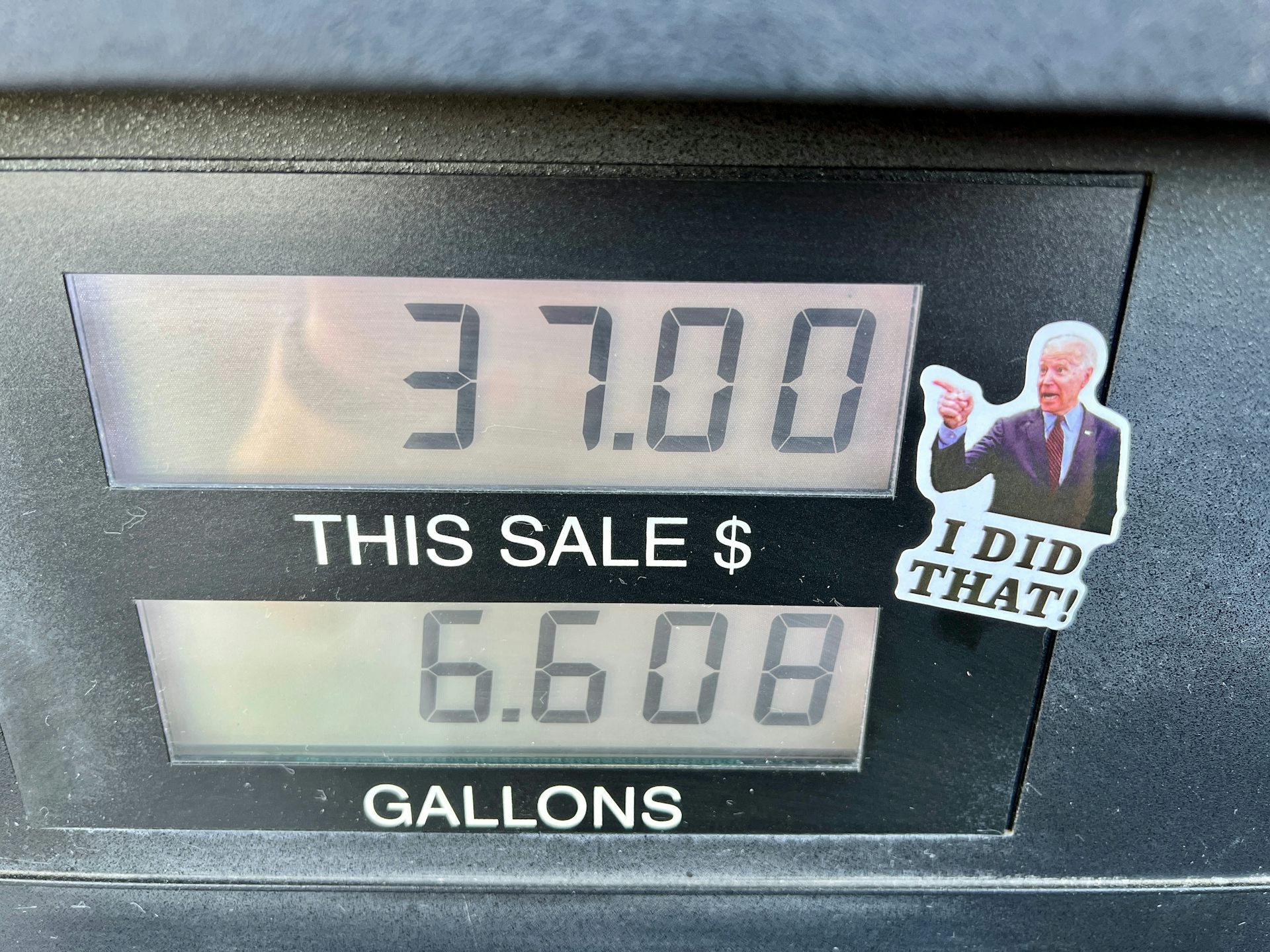
Meanwhile, Joe Biden has attempted to reduce dependence on fossil fuels with his green energy policy and other legislation. Yet at the same time he has overseen an increase in domestic oil production and promised motorists he will keep petrol prices low.
It’s an important promise in the US, a country whose love affair with cars is well known. Out-of-town shopping malls, long highways and a lack of government investment in public transportation have fuelled car dependency, with many cities being designed around huge road systems.
So it is perhaps unsurprising that pump prices are a significant factor influencing voters. Research has even shown that gasoline prices have an “outsized effect” on inflation expectations and consumer sentiment. As fuel prices go up, confidence in the economy goes down.
And while many European and Asian countries have shifted towards alternative energy sources, the US has not reduced its dependence on fossil fuels when it comes to transport. Electric models make up only 8% of vehicles sold in the US, compared to 21% in Europe and 29% in China.
Any rise in gasoline prices ahead of the US summer “driving season” – when holidays and better weather encourage more road travel and gasoline consumption is estimated to be 400,000 barrels per day higher than other times – would be a serious concern for the Democratic party.
Yet it’s also true that whoever is in the White House actually has limited ability to influence gasoline prices. Around 50% of the pump price is the cost of crude oil, the price of which is set by international markets.
And despite producing enough oil domestically to cover its consumption, the US continues to trade its oil around the world. Back in 2015, Congress voted to lift restrictions on US crude oil exports that had been in place for four decades, allowing US companies to sell their oil to the highest international bidder.
To complicate things further, some US refineries can only deal with a certain type of crude oil, which has to be imported. Neither international events or foreign production decisions are under the control of a US president.
Indeed, oil price spikes caused by political crises in other oil producing regions illustrate how continued dependence on oil itself, whether domestically produced or imported, leaves the US exposed to global market shocks which could in turn influence electoral outcomes.
After Russia’s full scale invasion of Ukraine in 2022 and production cuts from countries such as Saudi Arabia in 2023, the Republican party used a rise in gasoline prices to attack Biden’s environmental policies which had reduced domestic oil drilling and ended drilling leases in the Arctic.
Big oil, little oil
So while the US president has little say over the price of fuel that voters pay, domestic oil and gas regulations have a role to play, as oil producers make up a significant body of influence in the US.
Aside from the big firms backing Trump, the structure of the US oil industry is unique among oil producing states in that it is dominated by a very large number of small independent producers who earn money from the extraction and sale of oil from their land.
Some campaigners have blamed Biden for price rises at the pump
In most oil-producing countries, subsurface oil is owned by the state. But in the US, the mineral rights are owned by the private landowner who can earn royalties by allowing oil companies to drill on their land. In 2019, there were 12.5 million royalty owners in the US. Operating alongside them are some 9,000 independent fossil fuel companies which produce around 83% of the country’s oil and account for 3% of GDP and 4 million jobs.
Those companies drilling on state-owned land pay a royalty rate to the government, which up until recently was as low as 12.5% of the subsequent sales revenue. Biden’s decision to raise the rate to 16.67% did not go down well with oil producers.
Surging US oil production may help with the Democrats’ re-election bid, but rising gasoline prices will not – even though their levels depend on much more than Biden’s energy policies. Instead, it may be that the international economics of oil markets drive voters’ decisions – and determine who wins and who loses in November 2024.
Writing in 2014, Fanar Haddad says, no other event—not even the Iranian Revolution of 1979—has had “as momentous and detrimental an effect on sectarian relations in the Middle East as the war on and occupation of Iraq in 2003” (p. 67). And lest we forget, that debacle was not about the spreading of democracy in any way, shape or form. As Ian Sinclair reminds us in an excellent piece (see: WMD? or actually oil) an October 2003 Gallup poll of Iraqis residing in Baghdad found a full one per cent (yes, 1%) agreed with the premise that the US/UK desire to establish democracy was the main motivating factor for the invasion, while “43 per cent of respondents said the invasion’s principal objective was Iraq’s oil reserves.”
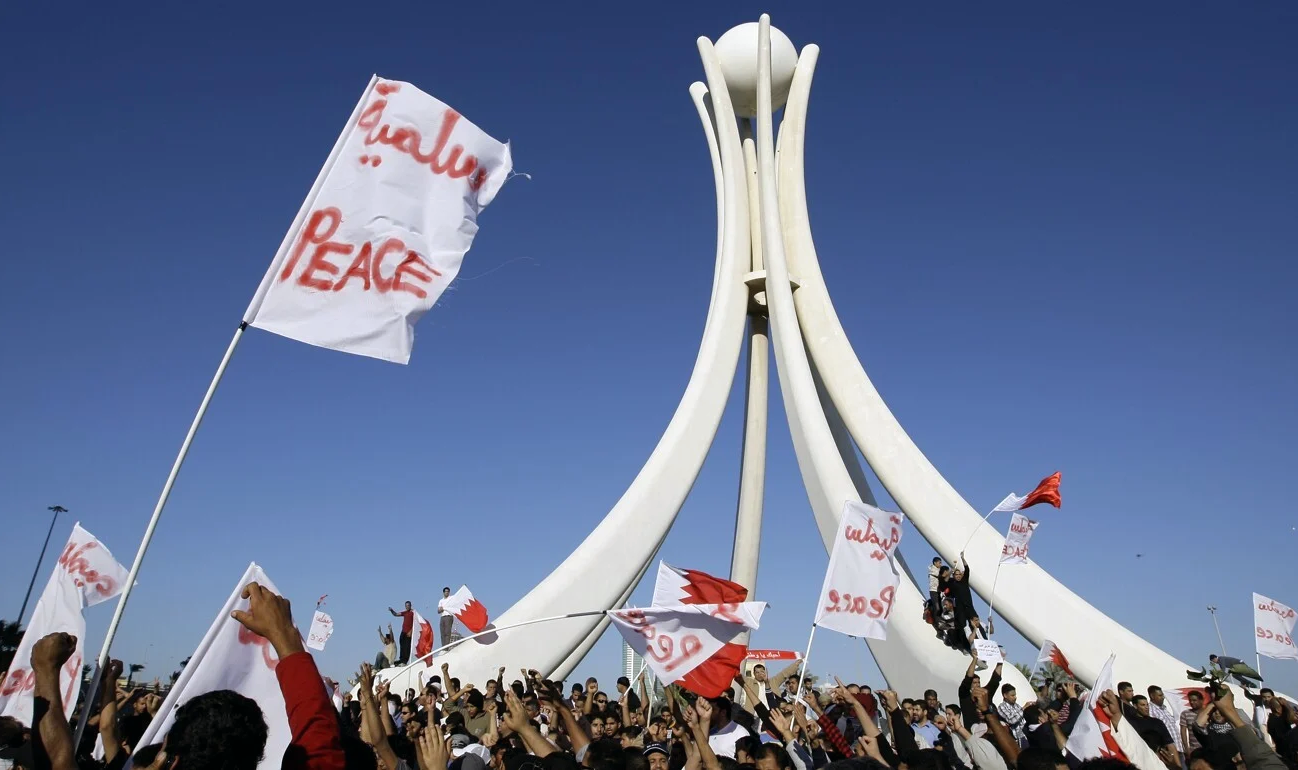
Matthiesen (2013) was in Bahrain in February 2011 when the Kingdom’s “Arab Spring” protests began, and records the initially peaceful character of the demonstrations, and not only peaceful but explicitly anti-sectarian (“neither Shia nor Sunni” the demonstrators chanted at the start). It is easy to forget now, as Jones (2015, p. 242) writes, “there was a spirit of optimism at that point, and many hoped Crown Prince Salman would successfully negotiate a compromise” (i.e., transition to a more accountable regime).
This opportunity evaporated within a month, on the 14th of March 2011, with the intervention of Saudi troops across the causeway. As Jones (2015) writes in his review of Matthiesen’s work, “it provides an account of Bahrain’s counter-revolution, the National Dialogue and the establishment of the Bahrain Independent Commission of Inquiry.” Matthiesen notes that the head of the commission had said, “you can’t say justice has been done when calling for Bahrain to be a republic gets you a life sentence and an officer who repeatedly fires on an unarmed man at close range gets seven years.”
Potter (2014) writes that in the wake of the Arab Spring, “in the Persian Gulf monarchies, there was a continuing standoff between Sunni and Shia in Bahrain and Saudi Arabia, and a widespread fear [be it imagined or tangible] of Iranian irredentism.” Jones (2015, p. 243) suggests that the central thesis of Matthiesen (213) is that some such monarchies have “deliberately stoked sectarianism, both as a means to fight the perceived Shia threat, as well as to divide and rule.” Proving intent is difficult acknowledges Jones; “Who can say whether leadership is foolish or wicked, or indeed both? But the outcome is the same.”
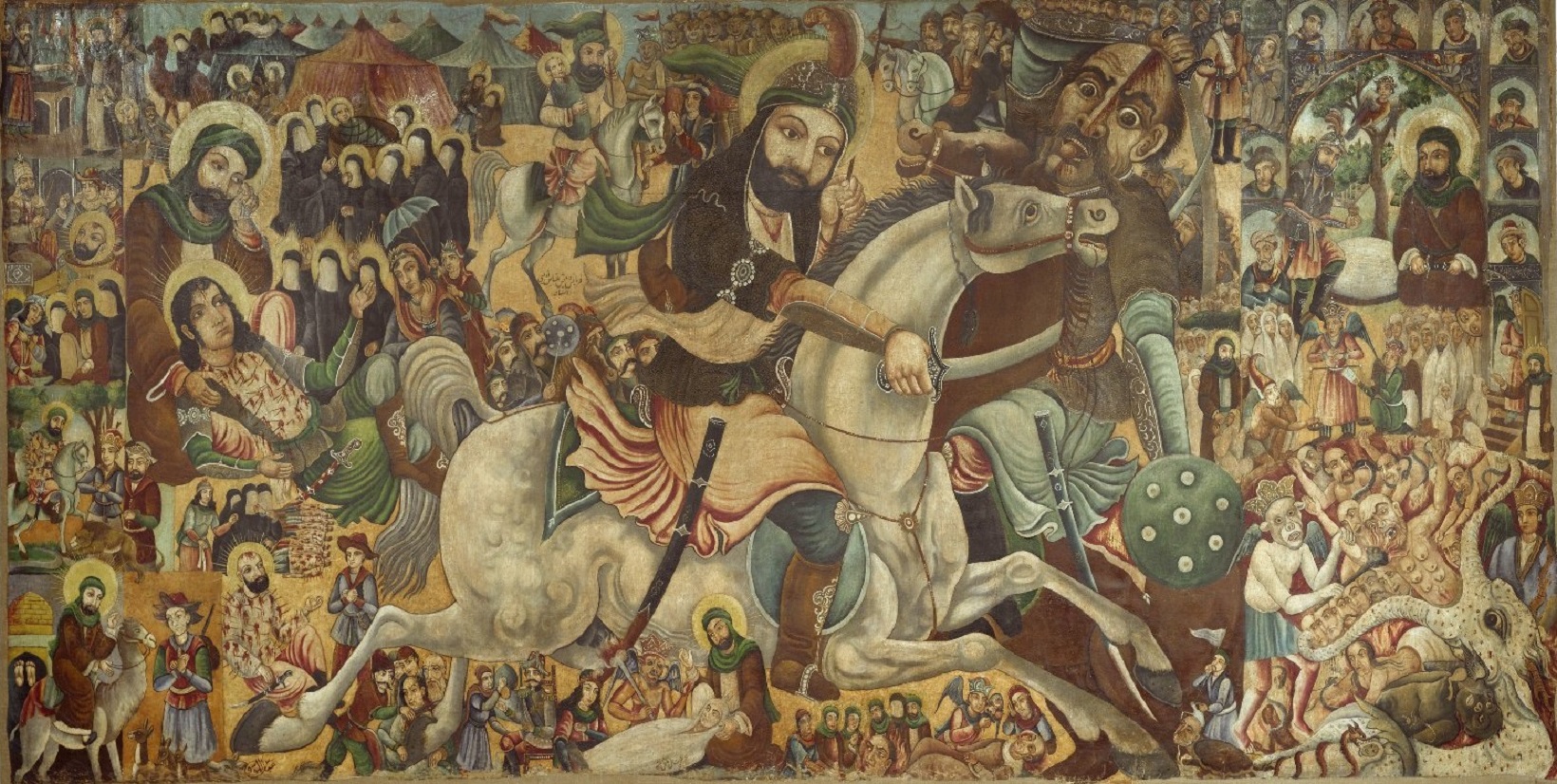
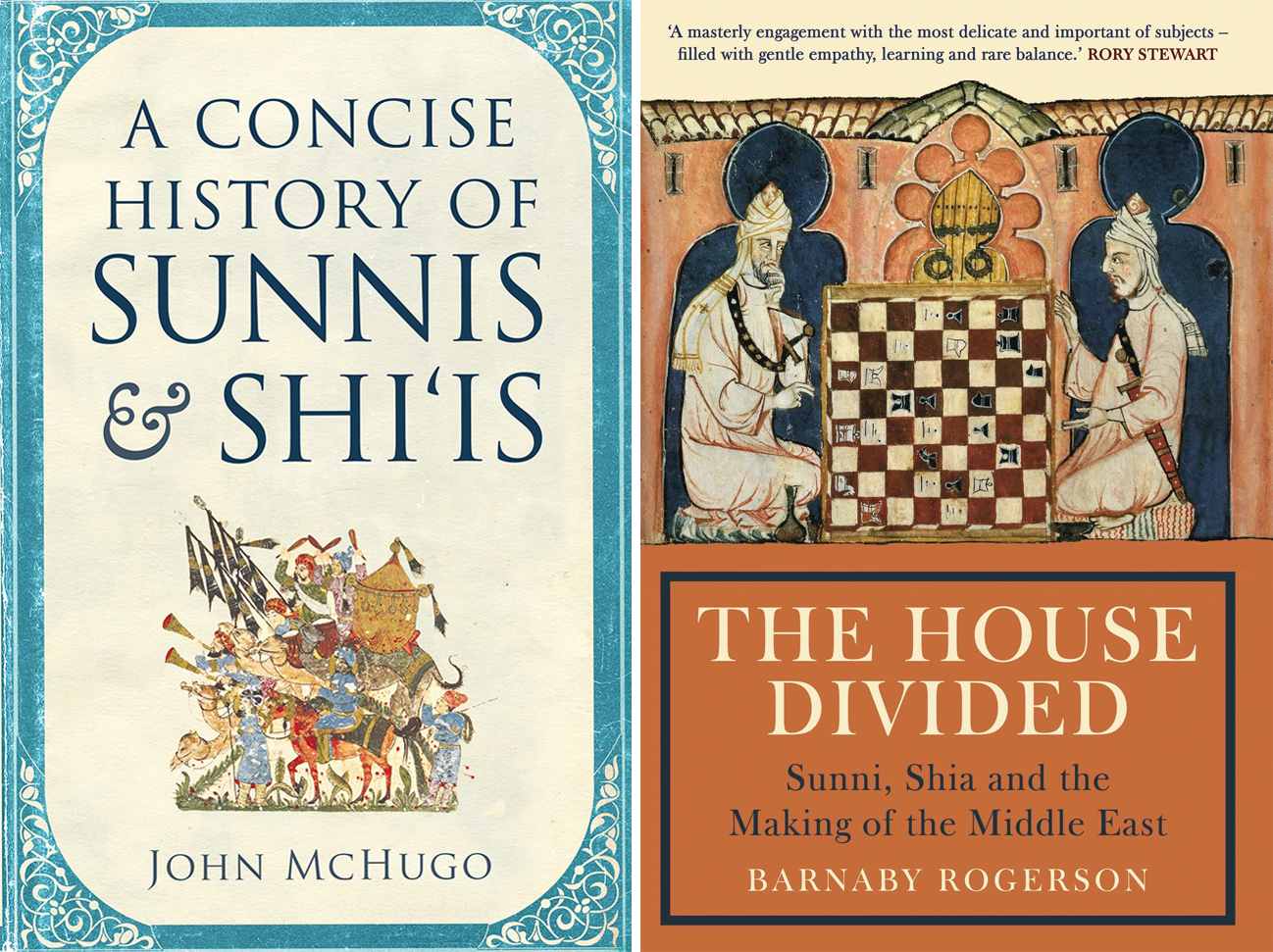
The schism (divide or split) between Sunni and Shia Islam emerged after the death of the Prophet Muhammad in 632, and disputes arose over who should shepherd the new and rapidly growing faith. Some believed that a new leader should be chosen by consensus; others thought that only the prophet’s descendants should become caliph. Muslims who wanted to select his successor, or Caliph, by following the traditional Arab custom (Sunna, ‘the way’) formed into a group known as Sunnis and elected Abu Bakr, a companion of Mohammed, to be the first caliph, or leader of the Islamic community. Others insisted the Prophet had designated his cousin and son-in-law Ali as his legitimate heir. This group was called Shia Ali, or ‘Party of Ali,’ (from which the word ‘Shia’ is now derived).
While the main responsibility of Sunni Caliphs was to maintain law and order in the Muslim realm, as descendants of the Prophet, Shia Imams (spiritual leaders) also provided religious guidance and were/are considered infallible — see, e.g., Axworthy (2017), Harney (2016) and Hubbard (2016). According to The Council on Foreign Relations (2023), Shias believe that Ali and his descendants are part of a divine order while Sunnis are opposed to political succession based on Mohammed’s bloodline.
Words matter
Framing the term “sectarianism” is fraught with both controversy and difficulty. It stems from the notion of a sect: a group with distinctive religious, political, or philosophical point of view and/or set of (ritualistic) practices. Most often the term has a religious connotation, such as a small group (minority) that has broken away from “orthodox” (mainstream) beliefs. According to Potter (2014, p. 2) Western writers typically, and mistakenly, characterise Sunnis as “orthodox” Muslims, and Shia as being “heterodox.” Sectarianism has come to have a negative connotation, denoting a group that sets itself off from society and thereby raises tensions. Haddad (2014, p. 67) notes that the term “sectarianism” does not have a definitive meaning, and prefers to view such groups in Iraq as “competing subnational mass-group identities.” It follows then that ‘sectarian’ identities, much like ethnic ones, are constantly changing and being both renegotiated (Smith, 2000) and reimagined (Anderson, 1983). I agree with the sentiments of Haddad (2014), until scholars are able to satisfactorily define “sectarianism,” a more coherent way of addressing the issue would be to use the term “sectarian” followed by the appropriate suffix: sectarian hate; sectarian unity; sectarian discrimination, and so forth.
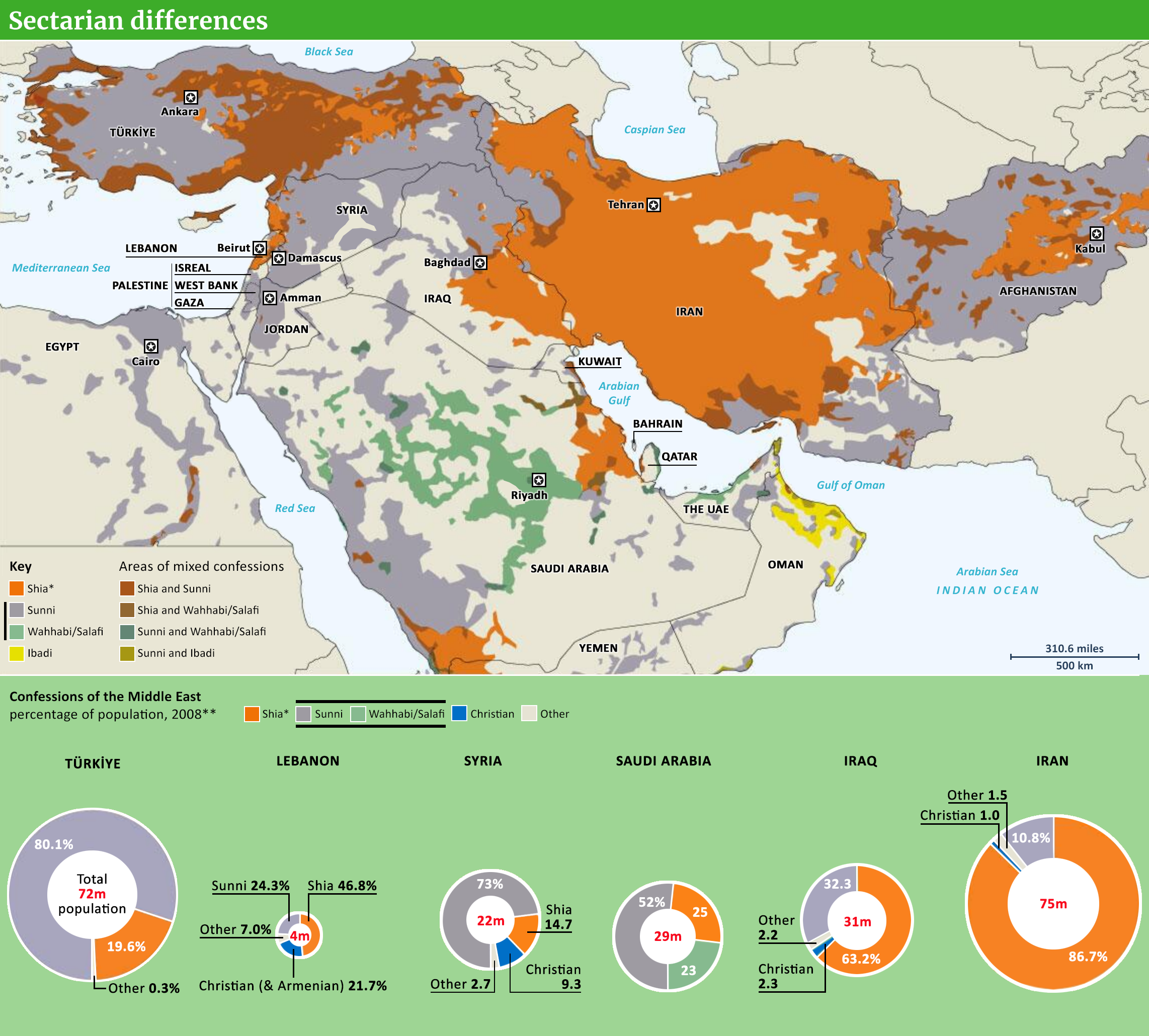
The map below gives details on the confessional divides on and around the Arabian peninsular. Although the data used to compile the map is dated the work is based on that carried out by Dr Michael Izady) and later used by The Financial Times of London is the latest as far as know. The Table that follows gives more recent figures but not geographical spread. As will become apparent when consulting the table and notes, the Association of Religion Data Archives (ARDA) relies heavily on the U.S. State Department’s annual International Religious Freedom Reports (that are submitted to the House of Congress annually in accordance with the International Religious Freedom Act of 1998). Those said reports paint a common theme: virtually all Gulf citizens are Muslim, but official demographics published by these countries do not delineate along confessional lines so, local media and think-tank reporting is relied upon.
To gain a deeper understanding of the region’s “sectarian” politics the following are worth investigating: Potter (2014) and Matthiesen (2013).
* Includes gnostic Alawites & Alevis. ** Dated; see Table below. Expand map.
Table: Religions in 2023 (%)
Country
Sunni
Shia
Other
Bahrain a
28
54
18
Kuwait b
66
17
17
Oman c
47
7
46
Qatar d
66
12
22
Saudi Arabia e
81
9
10
The UAE f
67
7
26
Iran
17
81
1
Iraq
35
61
4
Jordan
93
2
5
Egypt
90
< 1
10
Yemen
44
55
1
a
The US state department’s 2023 IRF report on Bahrain estimates the total population to be approximately 1.5 million with Bahrainis numbering around 720,000 (June 2023 – compare with Arabian Gulf data). The Bahraini government does not publish statistics that delineate its the Shia and Sunni Muslim populations but, “estimates from NGOs and the Shia community state Shia Muslims represent a majority (55 to 70 per cent).”
b
The IRF Report on Kuwait The U.S. government estimates the total population at 3.2 million (midyear 2022). U.S. government figures also cite the Public Authority for Civil Information (PACI), a local government agency, which reports that the country’s total population was 4.8 million in 2023. As of June, PACI reported there were 1.5 million citizens and 3.3 million noncitizens. PACI estimates 74.7 percent of citizens and noncitizens are Muslims. The national census does not distinguish between Shia and Sunni Muslims. Nongovernmental organizations (NGOs) and the media estimate approximately 70 percent of citizens are Sunni Muslims, while the remaining 30 percent are Shia Muslims (including Ahmadi and Ismaili Muslims, whom the government counts as Shia).
c
The IRF Report on Oman states that around 41 per cent of the Sultanate’s population constitutes foreign guest workers. Regarding the national Omani citizens, it is estimated that 45 per cent are Sunni, 45 per cent are Ibadi and most of the remainder are Shia (like its neighbours, the Omani government does not directly publish religious confession breakdowns). Note that the ARDA percentages in the Table above differ from those provided by the IRF.
d
According to the IRF Report on Qatar, as of 2023 Qataris made up approximately 11 per cent of the country’s total population and that “most citizens are Sunni, and almost all others are Shia.”
e
The IRF Report on Saudi Arabia estimates that around 85 per cent of Saudis are Sunni. The remainder are Shia, but in the oil-rich Eastern provinces of the country, this latter group comprises a substantial fraction (see: Oil’s corruptive capacity).
f
The 2023 IRF Report on the UAE suggests that approximately 11 per cent of the country’s population are Emiratis, of whom more than 85 per cent are Sunni. Most of the remainder, according to the report are are Shia citizens, “who are concentrated in the Emirates of Dubai and Sharjah.”
The narrative of a Sunni-Shia war is so prevalent it is now accepted without challenge – but Abdul-Azim Ahmed argues it is misleading to the point of inaccuracy.
‘But what about the great divide that is currently ripping apart the Middle-East?’
The question was asked to me at the launch of an exhibition about Muslim and Jewish relations at Cardiff University. The questioner was an elderly gentleman, clearly an academic, who had just finished reading part of the exhibition. I asked him to clarify.
‘The Sunni and Shia divide, that tore Islam asunder from the earliest days after the Prophet up to today’ he explained. As we continued our conversation, I discovered that this Professor of Chemistry felt the exhibition was intellectually dishonest for not acknowledging the impact of the division.
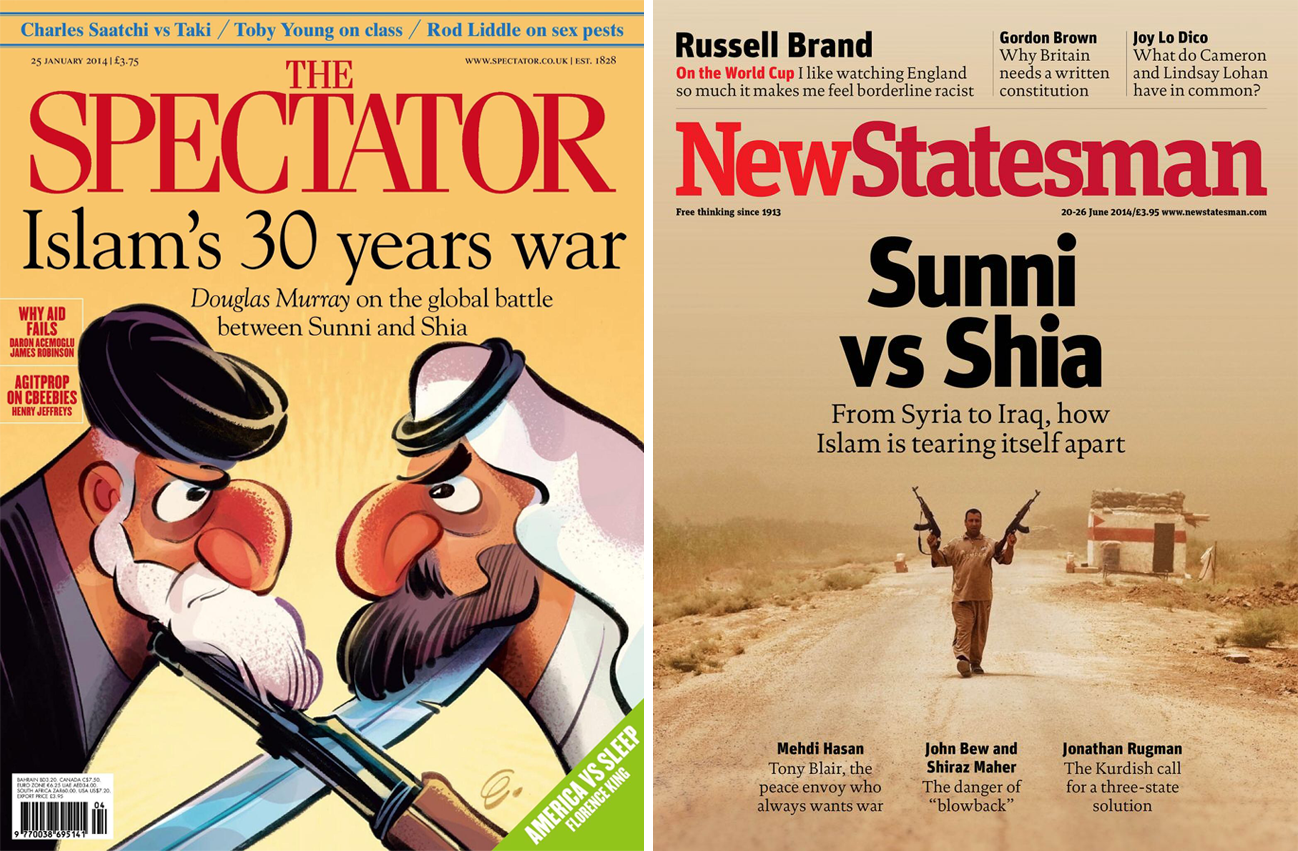
It is a view that is increasingly common. Namely, that much of the conflict in the Middle-East and to some extent North Africa, can be summarised as a struggle between warring factions within Islam -the Sunni majority and the Shia minority. You can read about it in respectable titles such as TIME magazine, The Spectator, even the New Statesman – all of whom covered it with front-page features, illustrating the conflict with stereotypical images of Arabs that tapped into centuries of Orientalist depictions of Muslims.
The Sunni versus Shia narrative has been featured in almost every newspaper I cared to check. Most recently, The Independent published a piece with the headline ‘The vicious schism between Sunni and Shia has been poisoning Islam for 1,400 years – and it’s getting worse’. The article of course mentioned the idea of the ‘Shia Crescent’ (a crescent-shaped area of land where there is a high Shia population) that is so ubiquitous in analysis it is almost cliché, not to mention being almost entirely useless as a tool for understanding geopolitical relationships.
The Sunni-Shia thesis essentially posits that a 7th century conflict of leadership amongst Muslims is the source of current Middle-Eastern unrest. The conflict led to two distinct theological groups emerging, the Ahlus Sunnah wal Jamaah (People of the Example of the Prophet and the Majority – conveniently shortened to ‘Sunni’) and the Shi’at Ali (the Party of Ali or ‘Shia’). The story goes that the two groups have been locked in a 1400 year conflict that has spanned continents, nation states and empires, and reaches its modern zenith in Syria, Bahrain, and the cold war between Iran and Saudi Arabia.
The problem with this thesis is that it is wrong. Not just partially wrong (as political analysis is, of course, always subject to interpretation) but so misleading, so inaccurate, and so detached from reality that it cannot be described as anything other than myth.
Even more problematic is that this myth has become so pervasive that gentlemen such as the professor I met consider it inconceivable to talk of Islam without talking of the Sunni-Shia conflict. Religious journalism has never been so dismally let down.
An Ancient Conflict?
The most common myth associated with the Sunni-Shia thesis is that Islam has been rent asunder by the sectarian conflict since its inception. This is simply reading history through solely modern eyes.
There was of course a dispute about religious authority following the death of the Prophet Muhammad. Historical specificities aside, the Sunni and Shia divide was largely a political one. There were no direct theological implications until the 10th and 11th centuries when orthodoxies began to settle and a Sunni Islam became distinct from a Shia Islam, led in separate directions as they developed distinct legal and interpretative traditions.
The lines have always been blurred between Sunnis and Shias, and they are so blurred that it is often difficult to make a distinction at all in the early centuries of Islam – for example, both Sunnis and Shias celebrate and claim for their own many of the same historical figures. Many of the Imams of Twelver Shiism are regarded as pious and orthodox by Sunni Muslims. Identities were fluid too, so that the revolution that put the Abbasid’s in power in the 9th century started as strongly Shia but ended as ardently Sunni.
Paul Vallely, writing in The Independent, argued that ‘the division between the two factions is older and deeper even than the tensions between Protestants and Catholics’. He is certainly correct that the division is older. But deeper? More significant? Certainly not historically, nor theologically. Sunni and Shia divergence in practice is really only intelligible to those very familiar with Islam in general.
There are differences in notions of orthopraxis (how and when to pray, for example). There are differences too in how scripture is assessed and interpreted – important yes, but historically, these have been the topic of scholarly dispute rather than military dispute. There have been times when Sunnis and Shias fought against each (the 7th century not being one of those times, importantly), but there have also been times when Shia have fought against Shia and Sunni have fought against Sunni.
The argument that Sunnis and Shias have been at each others throats since the 7th century is wrong in every way possible.
A War of Two Nations
So, if the claim of a Sunni-Shia conflict is historically incorrect, what about in the modern context?
What journalists and those who buy in to the Sunni-Shia narrative are doing is essentially replicating unquestioningly the rhetoric of two particular nation states. Saudi Arabia and Iran are perhaps the two most significant powers in the Middle-East, and since the Iranian Revolution in the 1970s, both have been vying for ascendency. Saudi Arabia especially has been exporting anti-Shia theology in a bid to delegitimise Iran and isolate it from other Muslim-majority nations.
Both nations recognise that amongst Muslims, any claim to legitimacy and authority to rule must be expressed in religious terms. Murtaza Hussain, a journalist at The Intercept, argues that Iran however, is less eager to push sectarian rhetoric than Saudi – ‘Iran’s statements are much more conciliatory because they know they can never achieve their goal of leading a largely Sunni Muslim world if they are openly sectarian’.
Conflict in the Middle-East is very much about resources and influence; it is of course however marked by religious rhetoric — rhetoric however that should rarely be taken at face value.
The Syrian Civil War
What about in nations such as Syria, where a Shia government is fighting against a Sunni populous? Surely here the claim of a Sunni-Shia conflict has merit?
Again the reality is more complicated. It was only in 1973 that modern Shias formally accepted Allawis (the religious sect to which the Assad family belong) as a branch of Shia-Islam. Musa al-Sadr, a senior Shia cleric in Lebanon, issued the fatwa, which brought centuries of ambiguity to an end. Until then — the Allawis were an unknown quantity. The religion was certainly influenced by Islam, but much else too, and Orthodox Sunnis and Shias both were sceptical of the high secretive tradition. Al-Sadr’s fatwa was as much motivated by politics as by piety — but it should underscore the fractured nature of religion and power in the Middle-East — a fracturing that is most clear in Syria today.
Journalists who consistently frame the conflict in sectarian terms also add to a pressure for religious groups to adhere to a particular political standpoint.
‘It’s called legitimacy by blackmail’ says James Gelvin, an academic and author who has researched the Middle East and Arab Spring. He explains to me the relevance of a Shia identity for Syria’s Assad Regime; ‘What the Syrian government has done is make itself stable by identifying the government with a particular sect, what they have done is forced other members of that sect into support of the government.’ It is a common tactic not only in Syria but in Bahrain also; ‘What that means of course is that the government tells minority communities, ‘if you do not support us, you’re dead, the majority will do something to you’’.
When journalists in the West repeat the ‘legitimacy by blackmail’ narrative in newspaper reports, they make the job of important bridge-builders, such as an Allawite Shia who doesn’t support the Assad regime, even more dangerous.
The same tatic is used by cheerleaders of the conflict, framing the Syrian Civil War as one between to Sunnis and Shias so as to garner theological support from certain quarters or to delegitimise claims of authority in other quarters. Muhammad Reza Tajiri, a Shia scholar in the United Kingdom, believes ‘the Syrian conflict certainly did not start on sectarian grounds, but as a result of opportunism from ‘scholars’ of both sides, the sectarian ideological issue is now inseparable from the conflict’.
Misleading Analysis
But it is clear that sectarianism is an element of the conflict; a devil’s advocate may argue that describing the conflict as Sunni-versus-Shia isn’t inaccurate. To truly appreciate how misleading it can be, try the following thought experiment.
Imagine a newspaper in the Middle-East, let’s say reporting in the 1990s. It is covering The Troubles of the UK and Ireland, specifically the Manchester Bombing of 1996. The headline of this piece is ‘The vicious schism between Protestant and Catholic has been poisoning Christianity for 500 years – and it’s getting worse’.
You begin reading the first few paragraphs of this article which professes to trace the history of the conflict between Britain and Ireland. It then locates the source of this conflict as beginning with Martin Luther nailing the Ninety-Five Theses to the door of Castle Church in Wittenburg.
The article concludes that the only way to resolve the dispute over Northern Ireland is sitting the Archbishop of Canterbury down with the Archbishop of Westminster to hammer out points of theological divergence, perhaps beginning with Transubstantiation. Only then, the author argues, can we hope for peace in Western Europe.
This bizarre article would never address the core of the issue, nor the problems being faced, nor offer any real solutions or clear ways forward. In fact, by choosing and forcing the narrative of a Christian sectarian conflict, it obfuscates the issue so drastically that it is useless.
It is the same with the Middle-East. Sectarianism is an aspect of Syria, but should the Muslim world come to some consensus about who should have been leader after the Prophet Muhammad, the difference at the centre of the original Sunni-Shia divide, the conflict in Syria would not cease.
Despite this, it isn’t uncommon to find articles talking about Syria, Bahrain or Pakistan, beginning with a discussion about 7th century Islam and disputes of who should be the next leader, Abu Bakr or Ali. Clearly this is neither insightful nor informed.
Alternative Understandings
If sectarianism is the wrong paradigm by which to understand conflicts in the Middle-East? How should they be understood?
‘The region has been economically stagnant’ believes James Gelvin, who has written extensively on the economic and social factors that led to the Arab Spring; ‘there is a largely young demographic, an unemployed youth, living amongst regimes that are incredibly oppressive’. Murtaza Hussain agrees that the problem is a combination of ‘economic failure’ and ‘identity politics’.
There is an emphasis sometimes put on the Saudi Arabia-versus-Iran cold war, but there are other pressures too. Most recently, the fracturing of relationships highlights how Qatar has emerged as a major player in the region. Saudi Arabia and Qatar have increasingly been hyping up tensions and rhetoric (a very Sunni-versus-Sunni conflict, to use the sectarian lens). Turkey too has very carefully developed links with post-Arab-Spring states, positioning itself as a potential moral voice for Muslims globally. The United States, which supports the Egyptian army with $3 billion annually, and Russia, which is propping up a beleaguered Assad Regime in Syria, also have deep interests in the region.
Conflicts are messy. Tony Blair’s speech in late April showed this most clearly. He advocated supporting intervention in Syria, but creating ties with Russia to fight Islamist threats. Yet Russia is supporting Assad, the same regime fighting the rebels Blair suggests offering support. His policy would quite literally force Britain and other Western nations to support two sides of the same war.
If experienced statesman like Blair can’t provide a coherent narrative without stumbling over themselves, we should certainly be wary of newspapers that simplify the problems of the Middle-East using the Sunni-versus-Shia schism.
Perhaps best to conclude then with James Gelvin:-
“In terms of the Middle East, the straw people always grasp at first is religion. They don’t do that in the case of the West. If there is a problem, it’s not a national problem, it’s not an economic problem, it has to be nailed on religion. It’s facile, simplistic and lazy analysis.”
References
Anderson, B. (1983). Imagined Communities: Reflections on the Origin and Spread of Nationalism. Verso Books.
Haddad, F. (2014). Secterian relations and sunni identity on post-civil war Iraq. In L. G. Potter (Ed.), Sectarian Politics in the Persian Gulf (pp. 67–115). Oxford University Press.
Louër, L. (2014). The State and Sectarian Identities in the Persian Gulf Monarchies: Bahrain, Saudi Arabia, and Kuwait in Comparative Perspective. In L. G. Potter (Ed.), Sectarian Politics in the Persian Gulf (pp. 117–143). Oxford University Press.
Jones, J. (2016). Sectarian Gulf: Bahrain, Saudi Arabia and the Arab Spring That Wasn’t [Book Review] Journal of Islamic studies, 27(2), 242–243. https://doi.org/10.1093/jis/etv108
Matthiesen, T. (2013). Sectarian Gulf: Bahrain, Saudi Arabia, and the Arab Spring That Wasn’t. Stanford University Press.
Potter, L. G. (Ed.) (2014). Sectarian Politics in the Persian Gulf. Oxford University Press.
Smith, A. D. (2000). The Nation in History: Historiographical Debates about Ethnicity and Nationalism. University Press of New England.
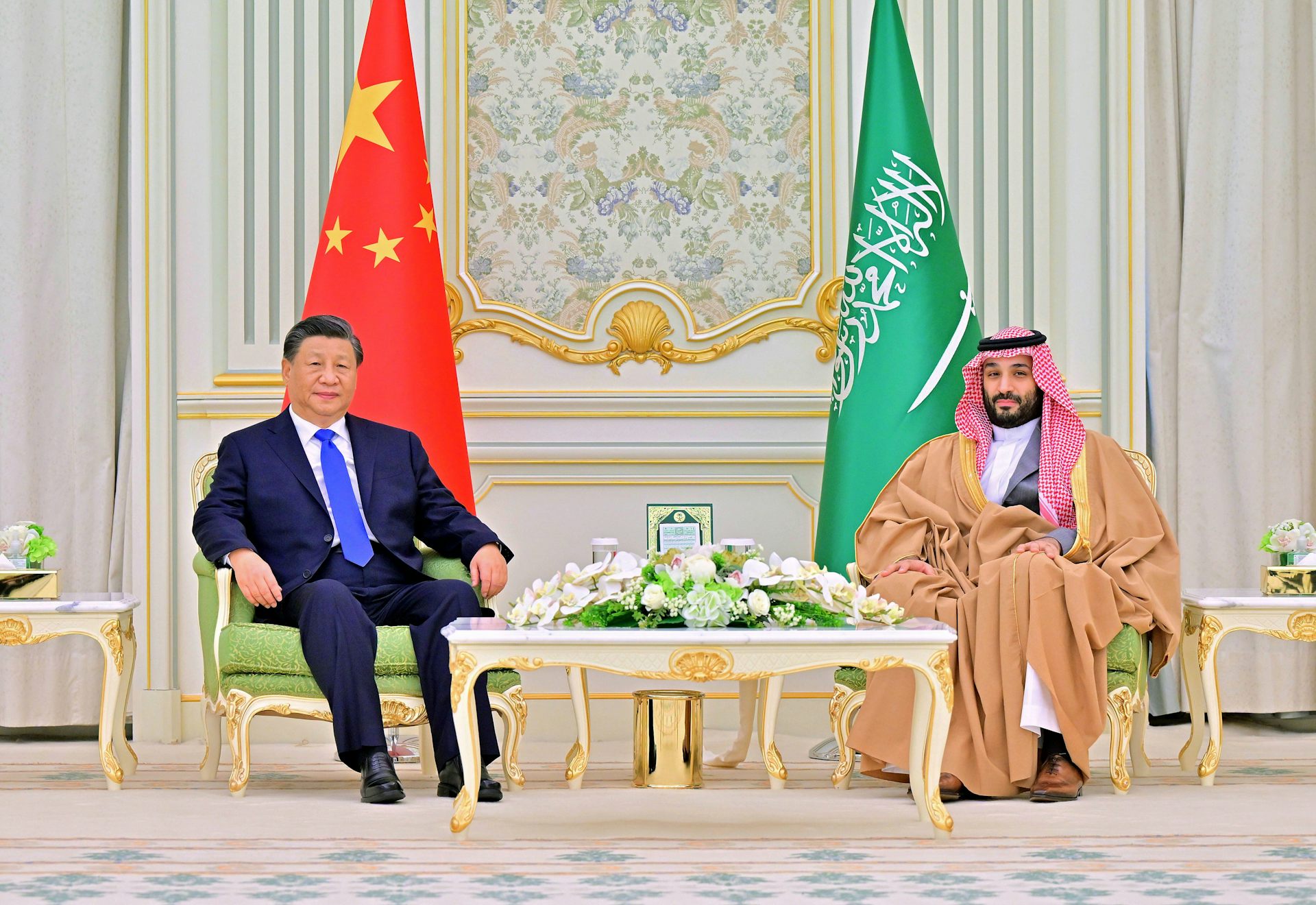
President Xi Jinping with Saudi Crown Prince Mohammed bin Salman Al Saud in December of 2022. Xinhua/Alamy Stock Photo
At the end of November 2022, UK prime minister Rishi Sunak announced that the “golden era” between Great Britain and China was over. China may not have been too bothered by this news however, and has been busy making influential friends elsewhere.
In early December, Chinese president Xi Jinping met with the Gulf Cooperation Council (GCC) – a group made up of Bahrain, Kuwait, Oman, Qatar, Saudi Arabia and the United Arab Emirates – to discuss trade and investment. Also on the agenda were talks on forging closer political ties and a deeper security relationship.
This summit in Saudi Arabia was the latest step in what our research shows is an increasingly close relationship between China and the Gulf states. Economic ties have been growing consistently for several decades (largely at the expense of trade with the US and the EU) and are specifically suited to their respective needs.
Simply put, China needs oil, while the Gulf needs to import manufactured goods including household items, textiles, electrical products and cars.
China’s pronounced growth in recent decades has been especially significant for the oil rich Gulf state economies. Between 1980 and 2019, their exports to China grew at an annual rate of 17.1%. In 2021, 40% of China’s crude oil imports came from the Gulf – more than any other country or regional group, with 17% from Saudi Arabia alone.
China has been using over 14 million barrels of oil a day since 2019. Nate Samui/Shutterstock
China has benefited from increasing demand for its manufactured products, with exports to the Gulf growing at an annual rate of 11.7% over the last decade. It overtook the US in 2008 and then the EU in 2020 to become the Gulf’s most important source of imports.
These are good customers for China to have. The Gulf economies are expected to grow by around 5.9% in 2022 (compared with a lacklustre 2.5% predicted growth in the US and EU) and offer attractive opportunities for China’s export-orientated economy. It is likely that the fast-tracking of a free trade agreement was high on the summit’s agenda in early December.
Strong ties
The Gulf’s increased reliance on trade with China has been accompanied by a reduction in its appetite to follow the west’s political and cultural lead.
As a group, it was supportive of the west’s military action in Iraq for example, and the broader fight against Islamic State. But more recently, the Gulf notably refused to support the west in condemning Russia’s invasion of Ukraine. It also threatened Netflix with legal action for “promoting homosexuality”, while Qatar has been actively banning rainbow flags supporting sexual diversity at the FIFA men’s World Cup.
So Xi’s visit to Saudi Arabia was well timed to illustrate a strengthening of this important partnership. And to the extent that anything can be forecast, a deepening of the Gulf-China trade relationship seems likely. On the political front, however, developments are less easy to predict.
China is seeking to safeguard its interests in the Middle East in light of the Belt and Road initiative, its ambitious transcontinental infrastructure and investment project.
But how much further might the Gulf states be prepared to sacrifice their longstanding security pacts with western powers (forged in the aftermath of the second world war) in order to seek new ones with the likes of Beijing? Currently, America has military bases (or stations) in all six Gulf countries, but it is well documented that the GCC is seeking ways to diversify its self-perceived over-reliance on the US as its primary guarantor of security (a sentiment within the bloc that was pronounced while Obama was president, less so with Trump, but on the rise again with Biden).
In the coming period, the GCC will need to decide which socioeconomic path to pursue in the post-oil era where AI-augmented, knowledge-based economies will set the pace. In choosing strategic ties beyond trade alone, the Gulf states must ask whether the creativity and innovative potential of their populations will be best served by allegiances to governments which are authoritarian, or accountable.
Here’s a few of the articles I’ve had published with Middle East Policy:
Wiley Online Library (2020, September 12)
A
Lekhraibani, R., Rutledge, E. J. & Forstenlechner, I. (2015). Securing a dynamic and open economy: the UAE’s Quest for Stability, Middle East Policy, 22(2), 108–124. https://doi.org/10.1111/mepo.12132 🗒 Abstract etc.
As Schwarz (2016) recalls, Winston Churchill once described Iran’s oil – “which the U.K. was busy stealing at the time” — as “a prize from fairyland far beyond our brightest hopes.” Churchill was right, but was seemingly unaware at the time that this would be the kind of fairy-tale blessing whose treasures almost invariably come tied with various terrible curses.
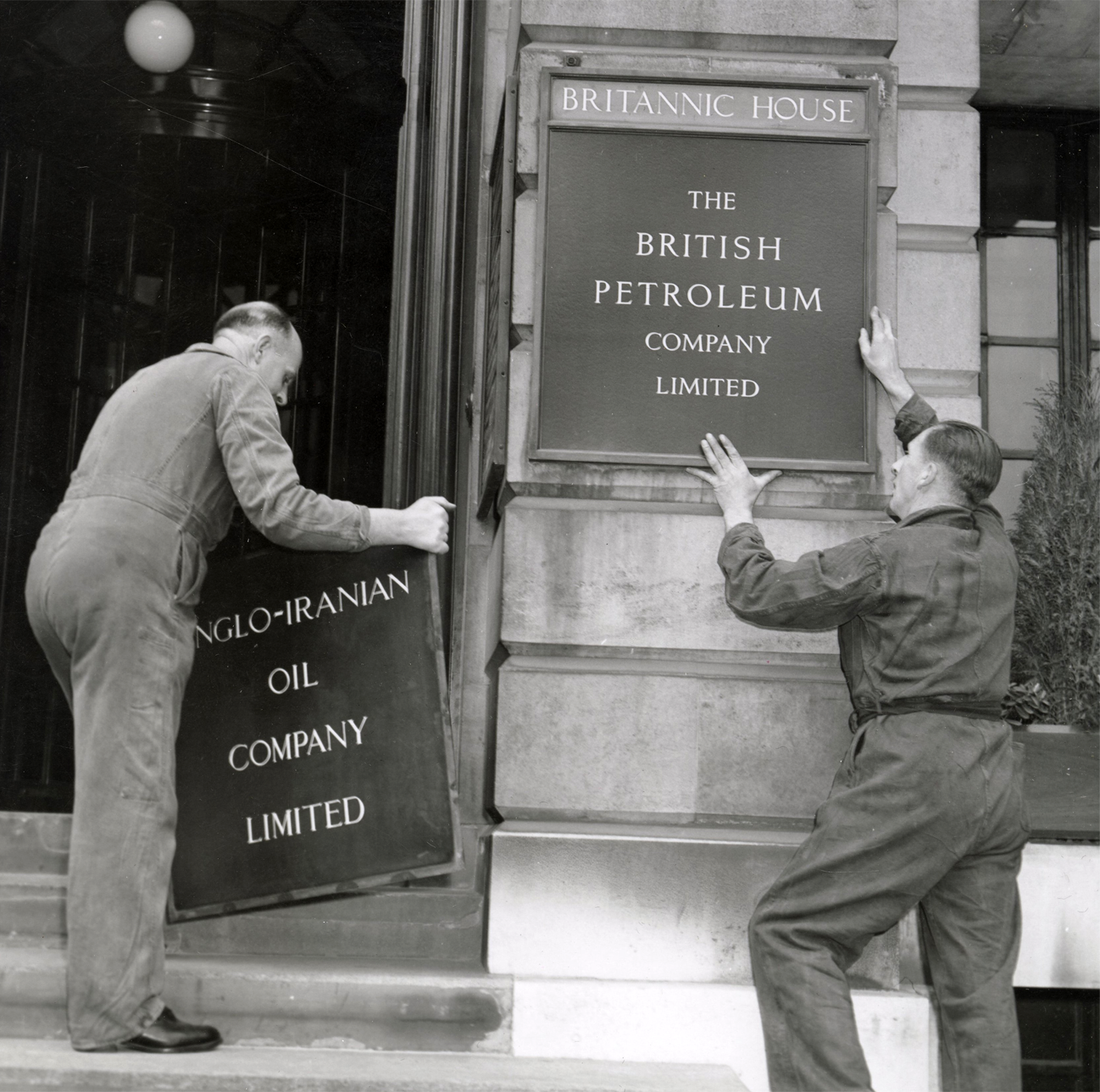
Recall that BP which is now British Petroleum (or ‘Beyond Petroleum’) was once, basically, British Persian.
Change in name onlyAnglo-Iranian
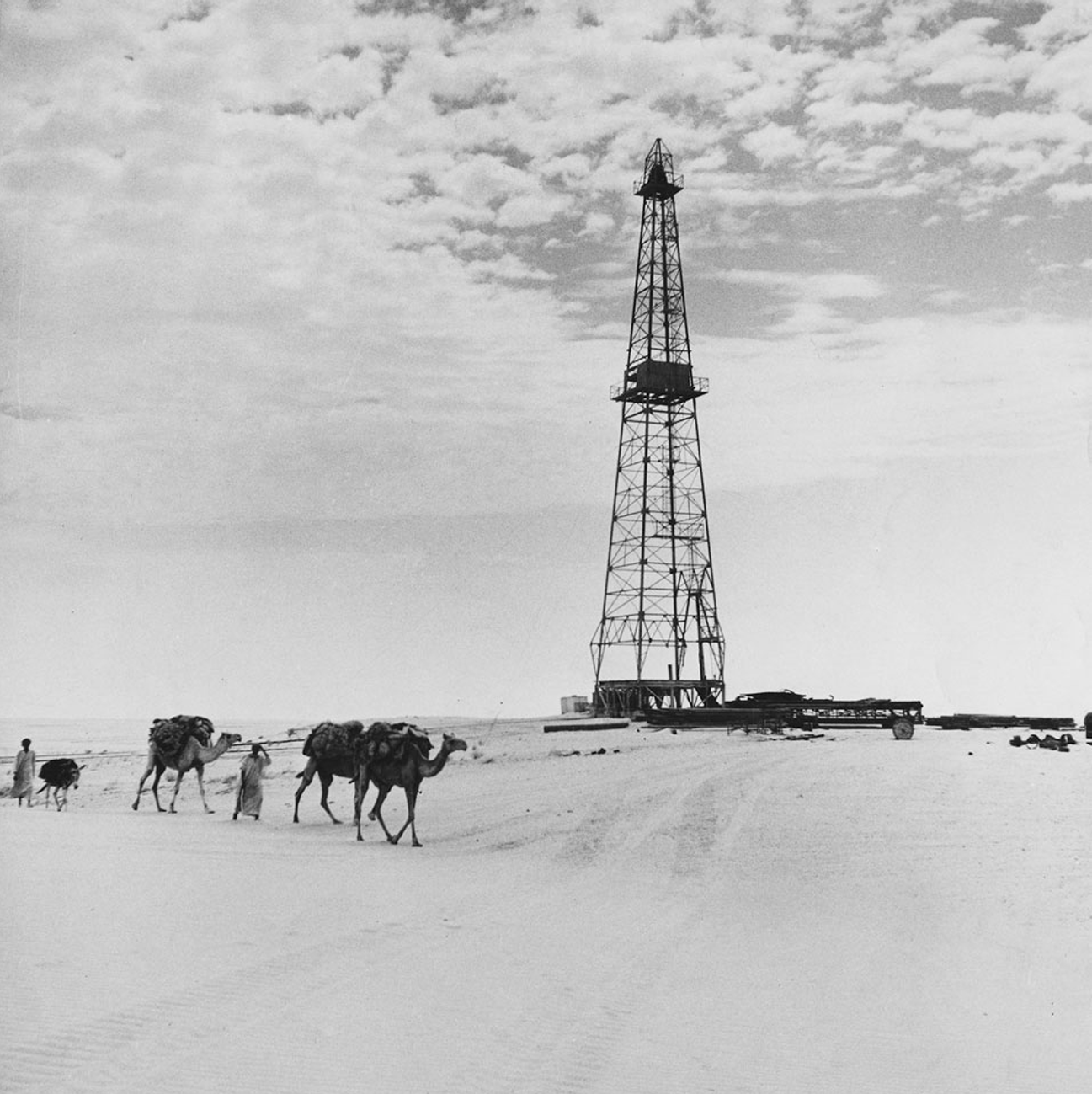
Its all about the (the control of the) oil
1945
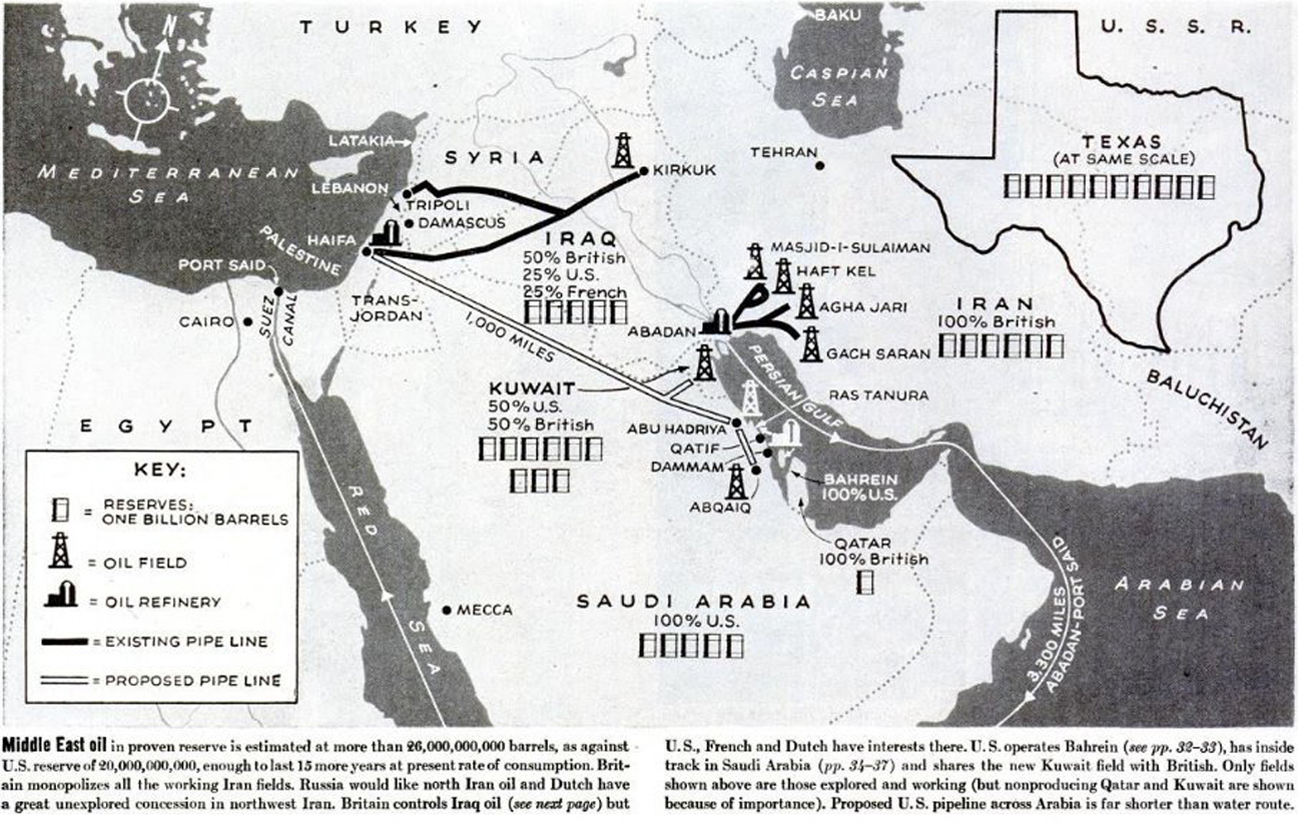
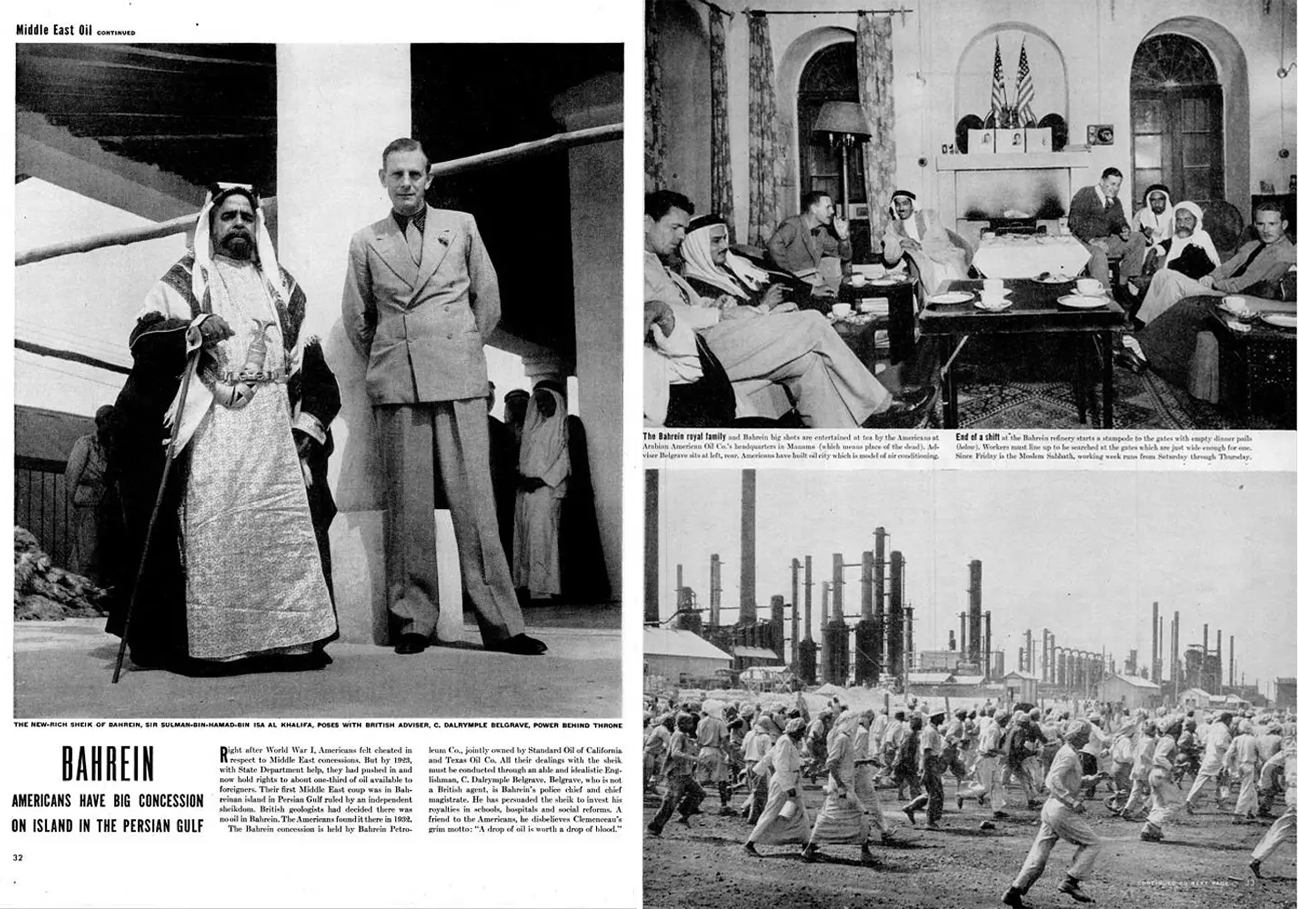
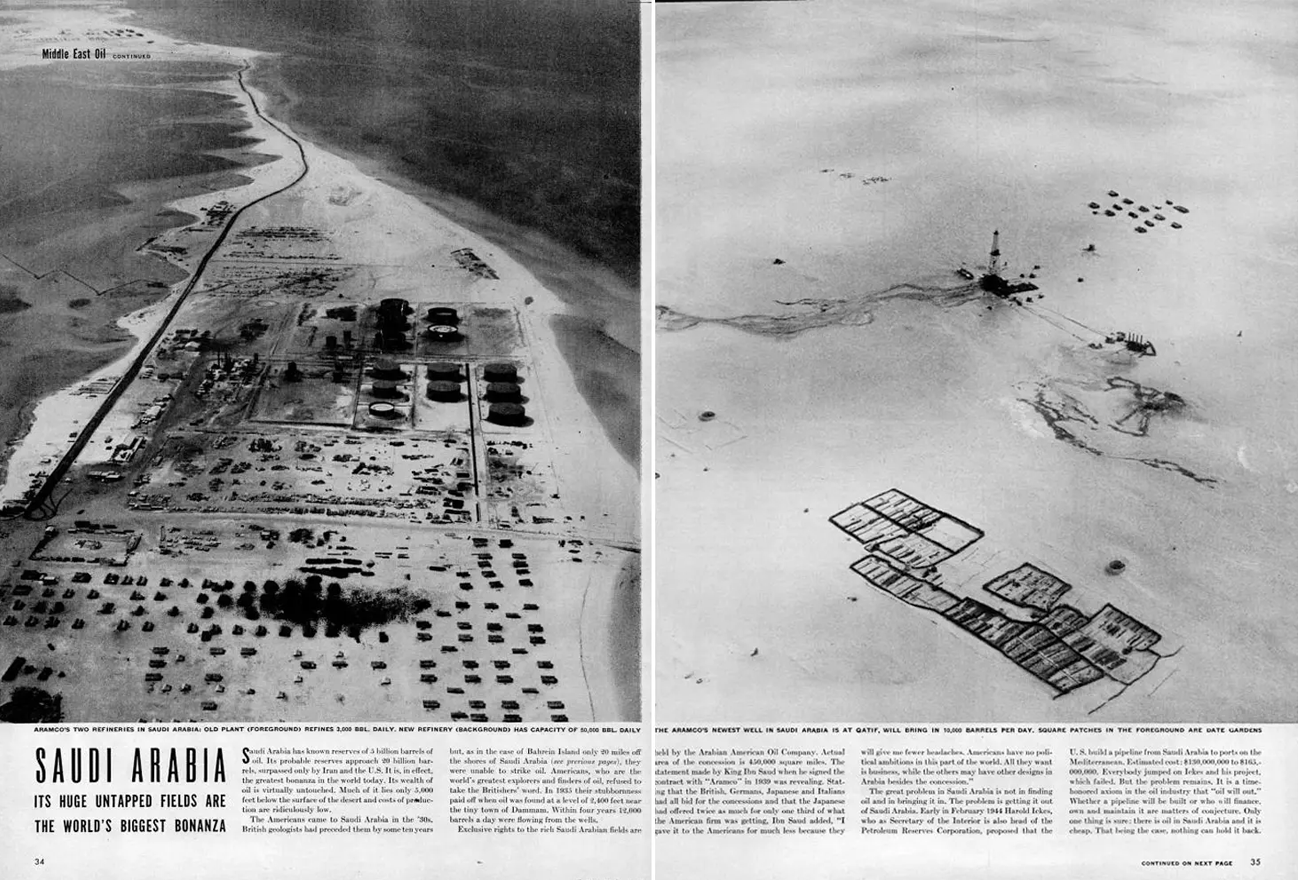
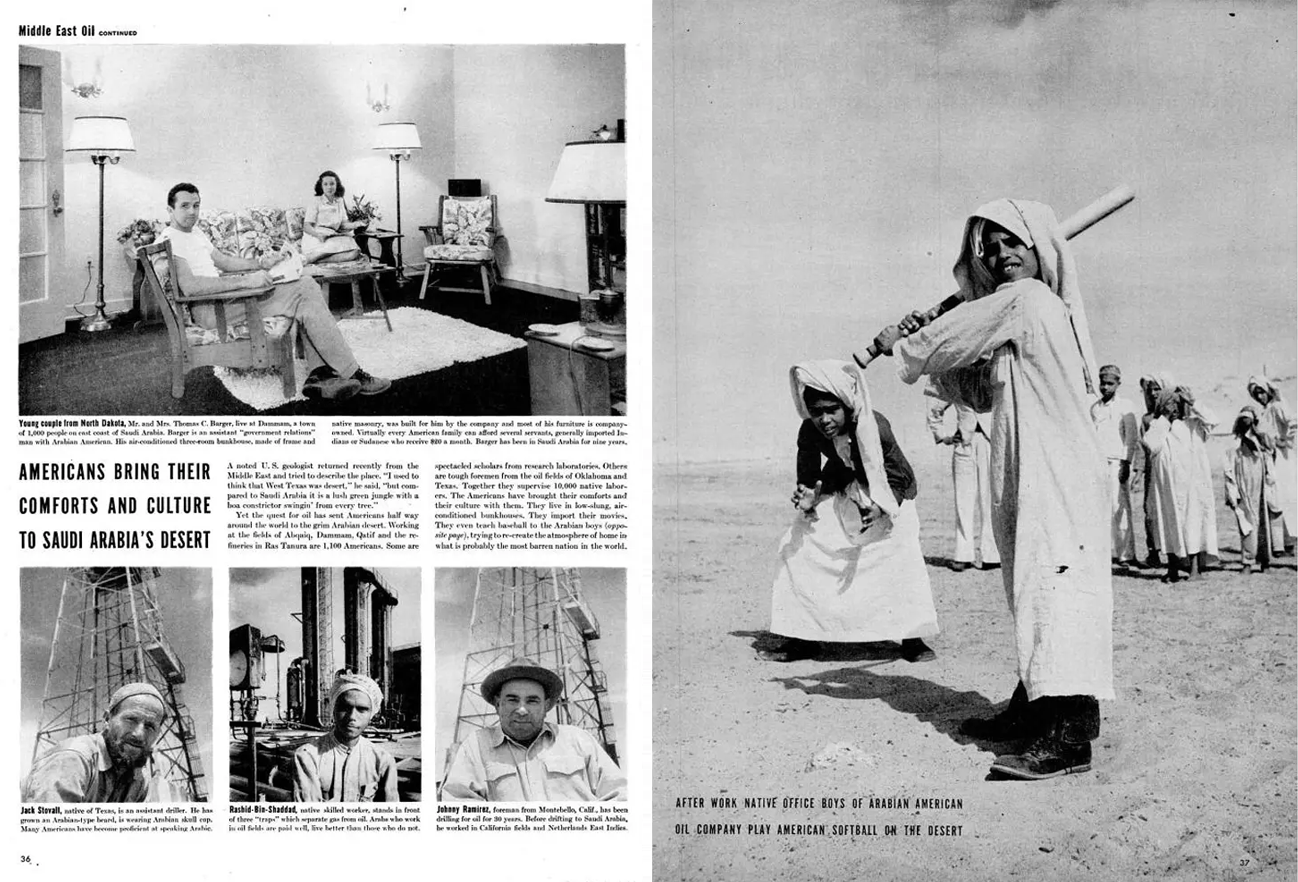
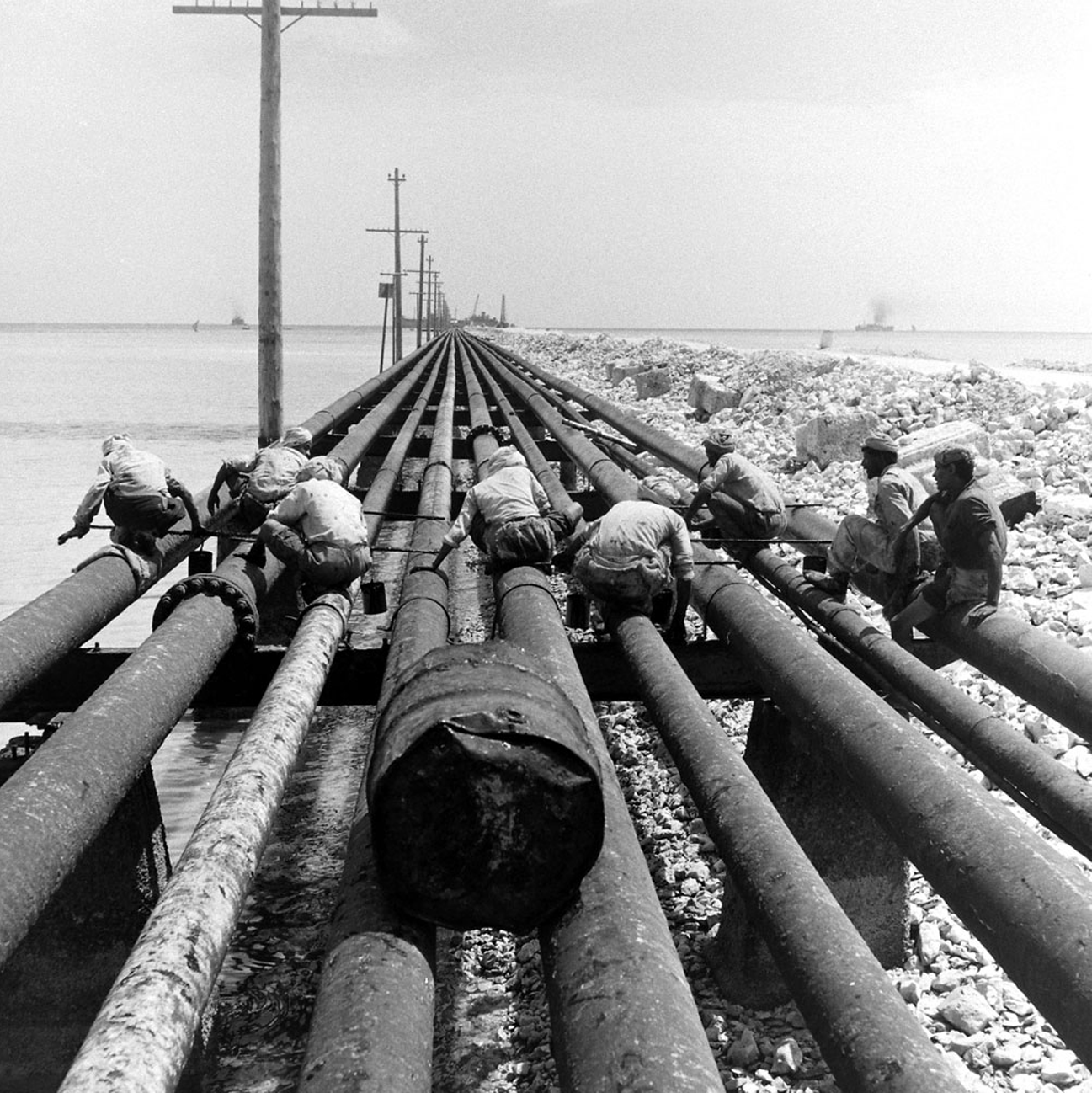
It is hard not to see how the commercial extraction and exportation of oil since before the creation of the modern nation state, in most instances, on the Arabian peninsular has not had an elemental impact on these countries’ political and socioeconomic trajectories since the early decades of the last century.
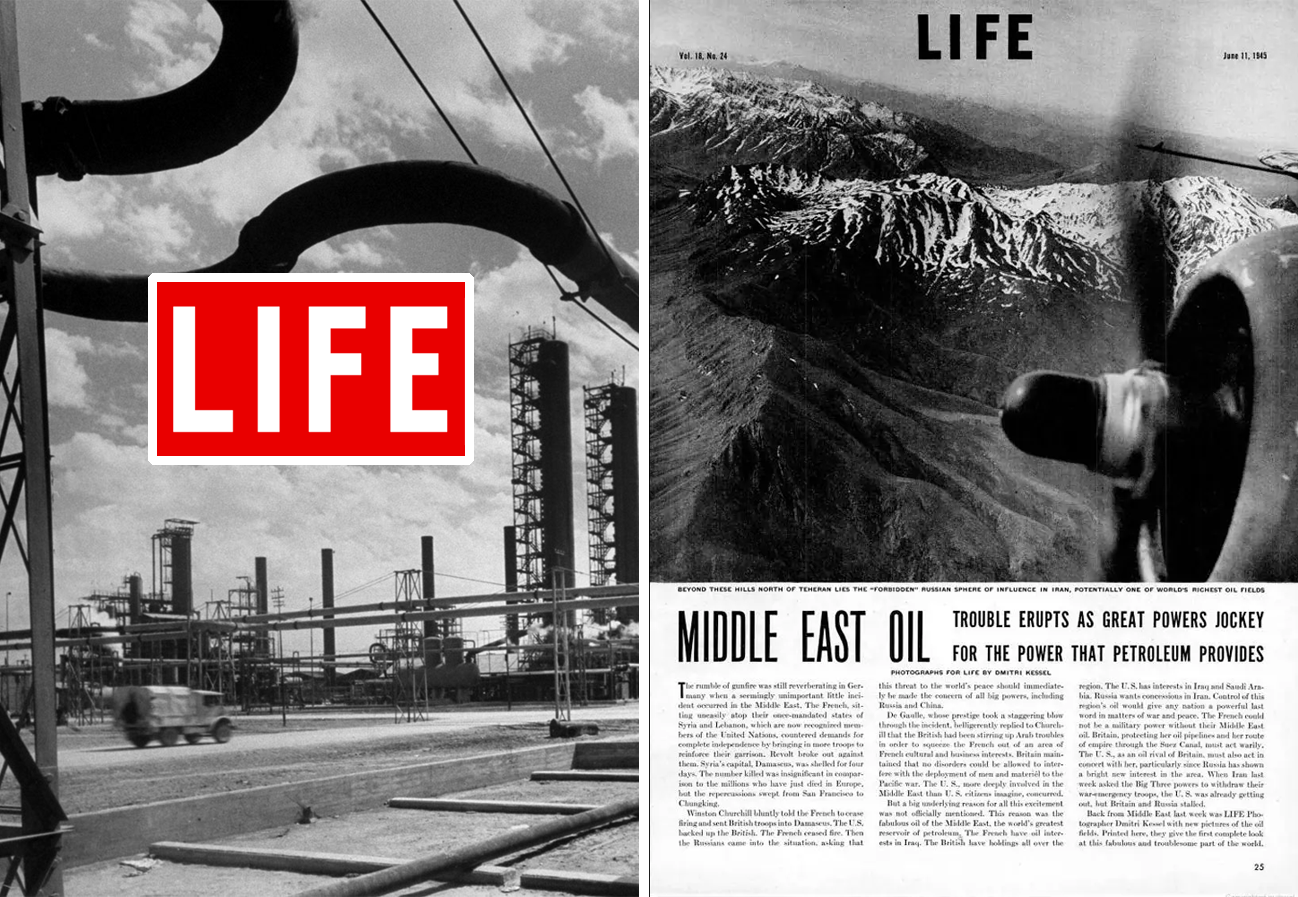
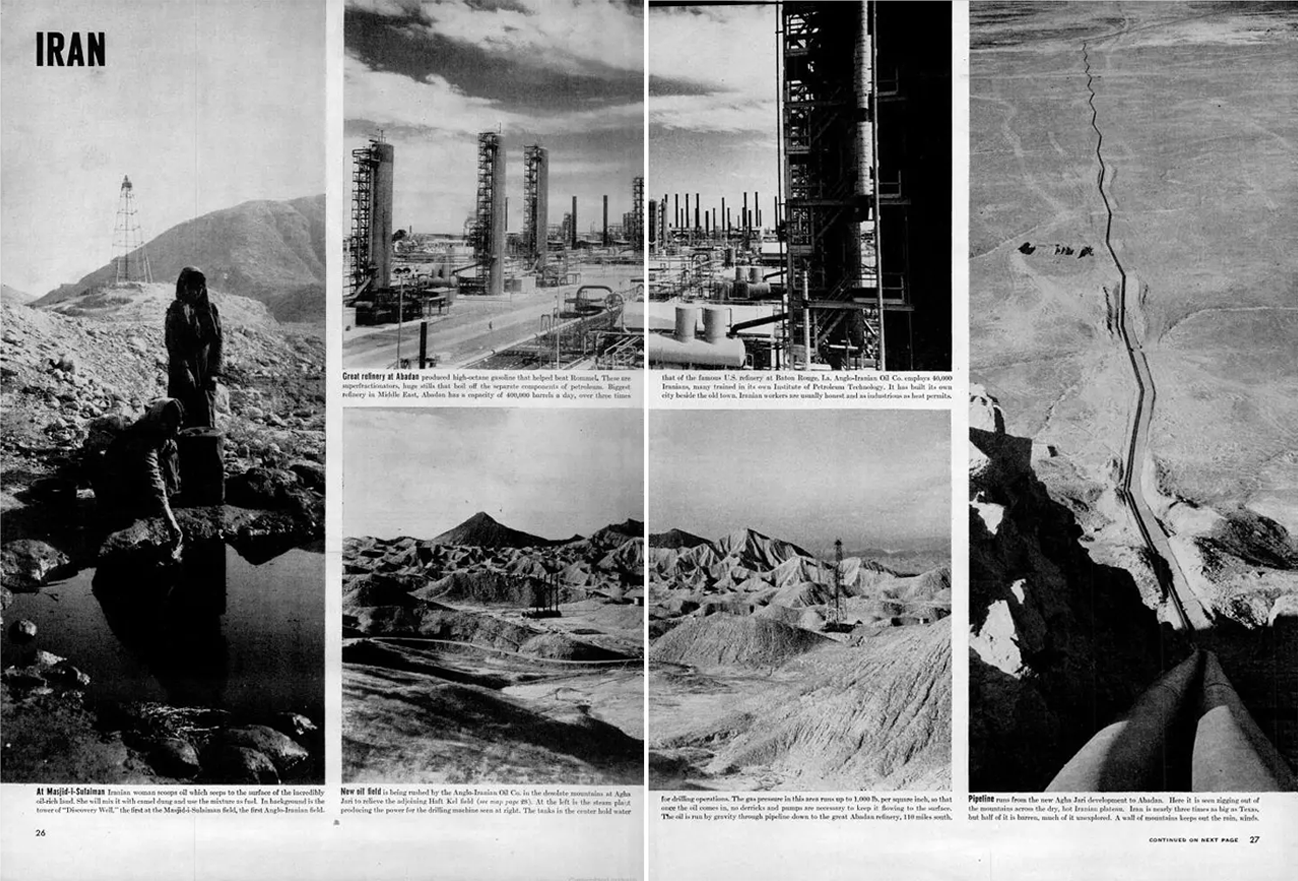
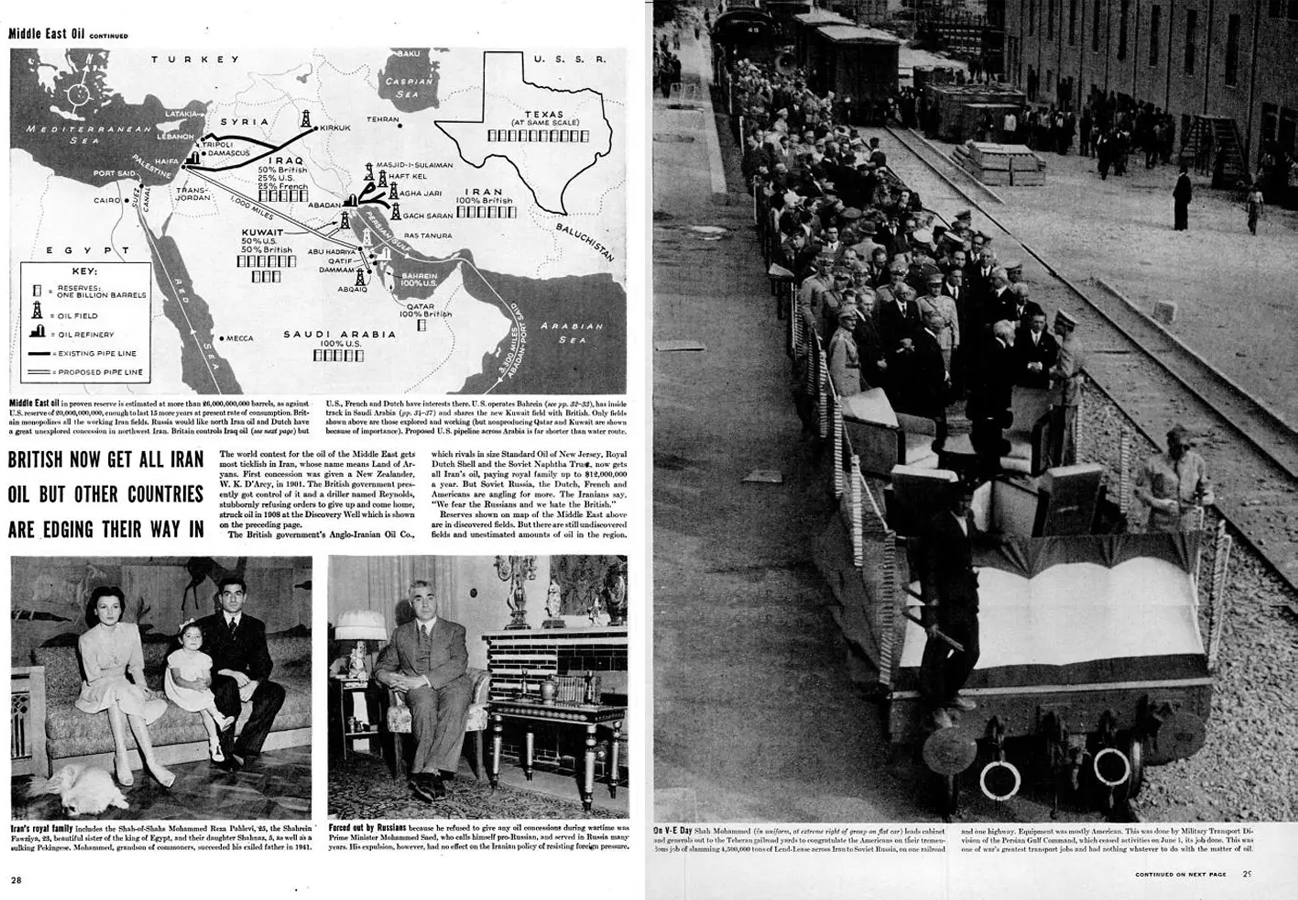
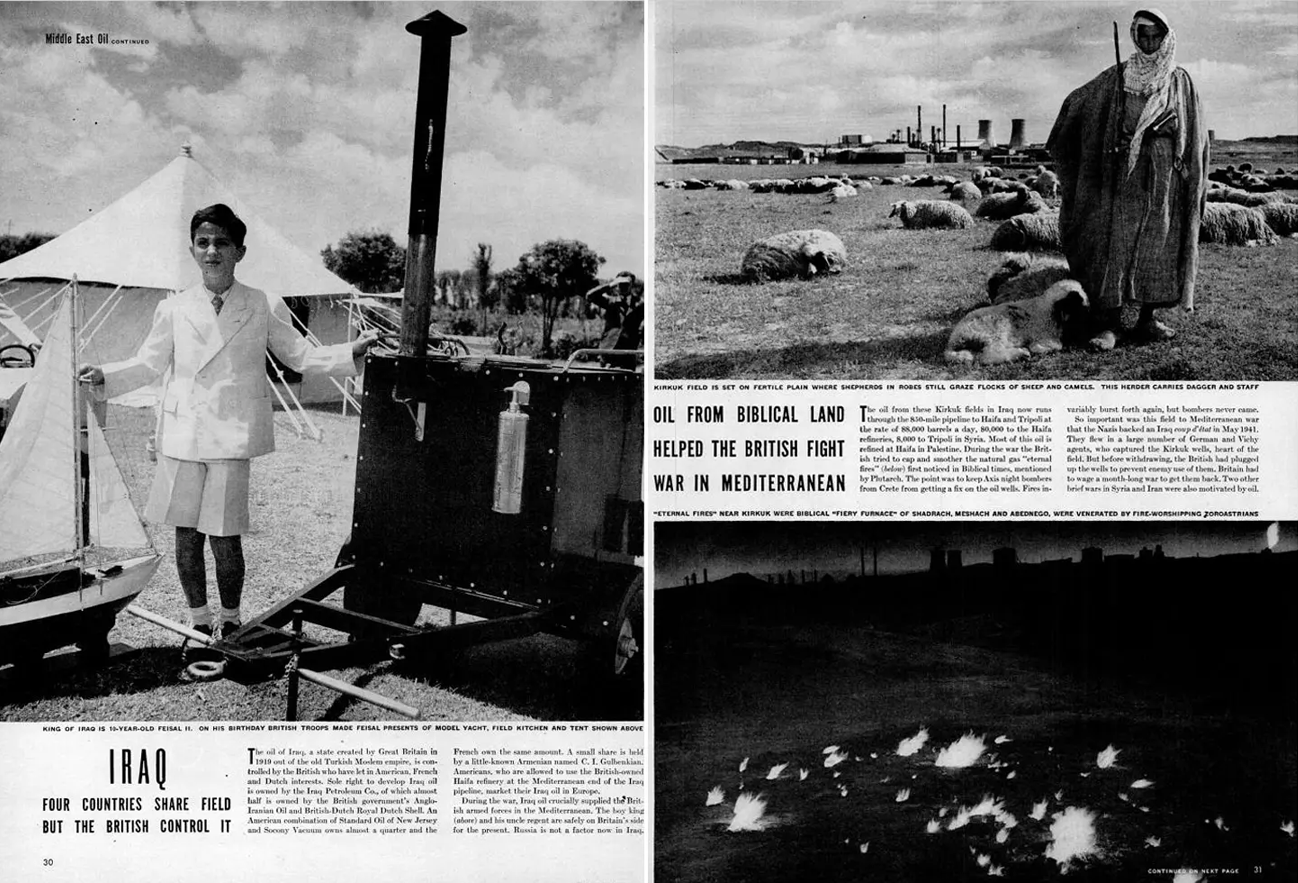
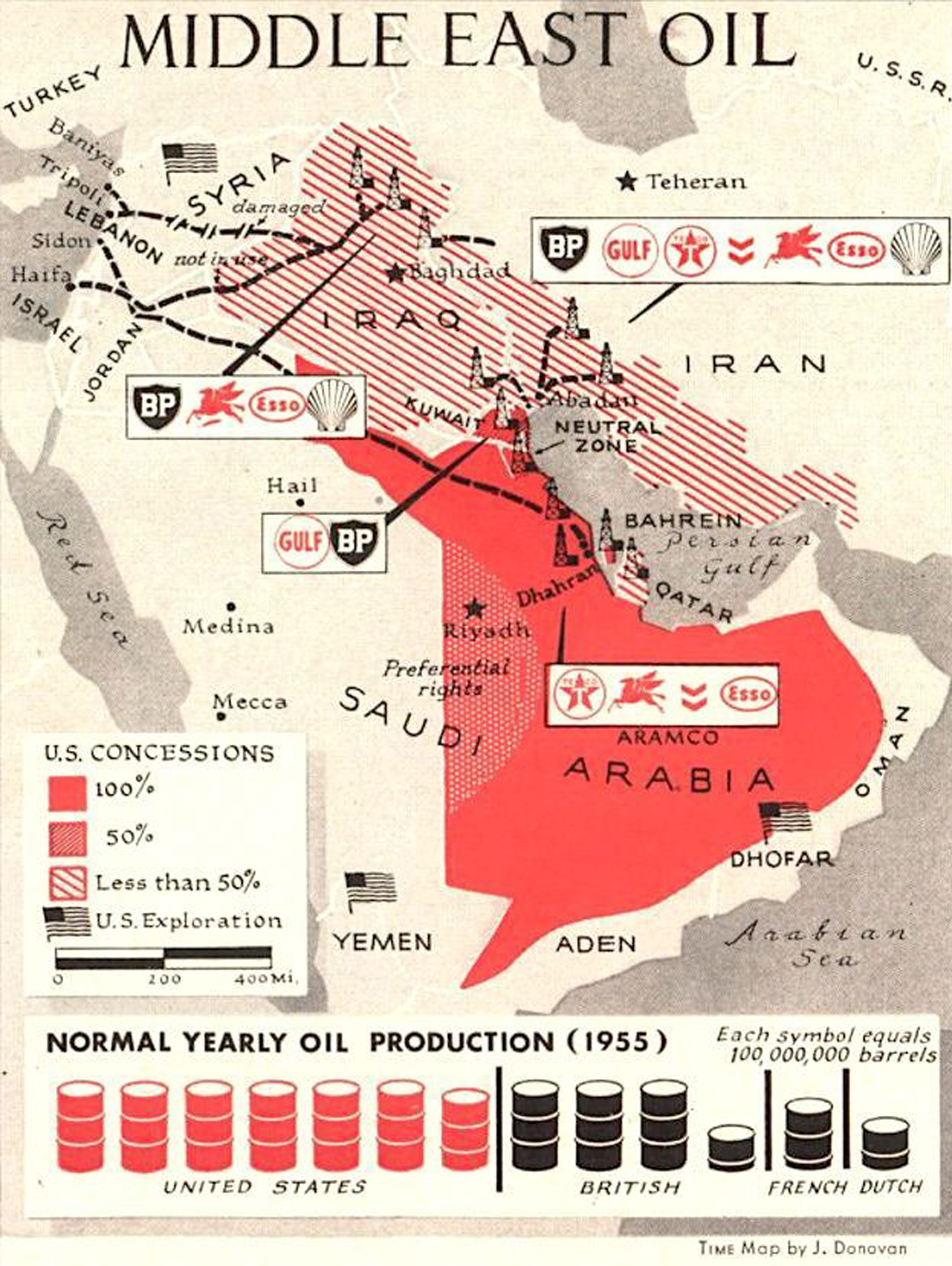
Life Magazine, June 1945.Iran“The Map”IraqBahrain (and the Brits)Saudi Arabia(un)leashed…
As per a 1957 Time magazine piece, “THOUGH Britain has populated the Middle East with British political advisers to Arab rulers, and for a time seemed to be running the whole show, in economic fact the region has in recent years been dominated by U.S. companies, who stay out of local politics. They produce about twice as much of the Middle East’s oil as the British. and own nearly 60% of the area’s known reserves. Tiny, treeless Kuwait. the richest producing state in the rich Middle East, is, for example, a sheikdom under British protection and equipped with a British political agent, but its British producing company is half-owned by Gulf Oil (U.S.). Americans also team up with British. Dutch and French interests in Iraq. But Saudi Arabia’s Aramco is entirely an American concession—a syndicate formed by Standard Oil of California, the Texas Co. and Jersey Standard Oil (Esso), plus a smaller share to Mobil Oil.”
1955
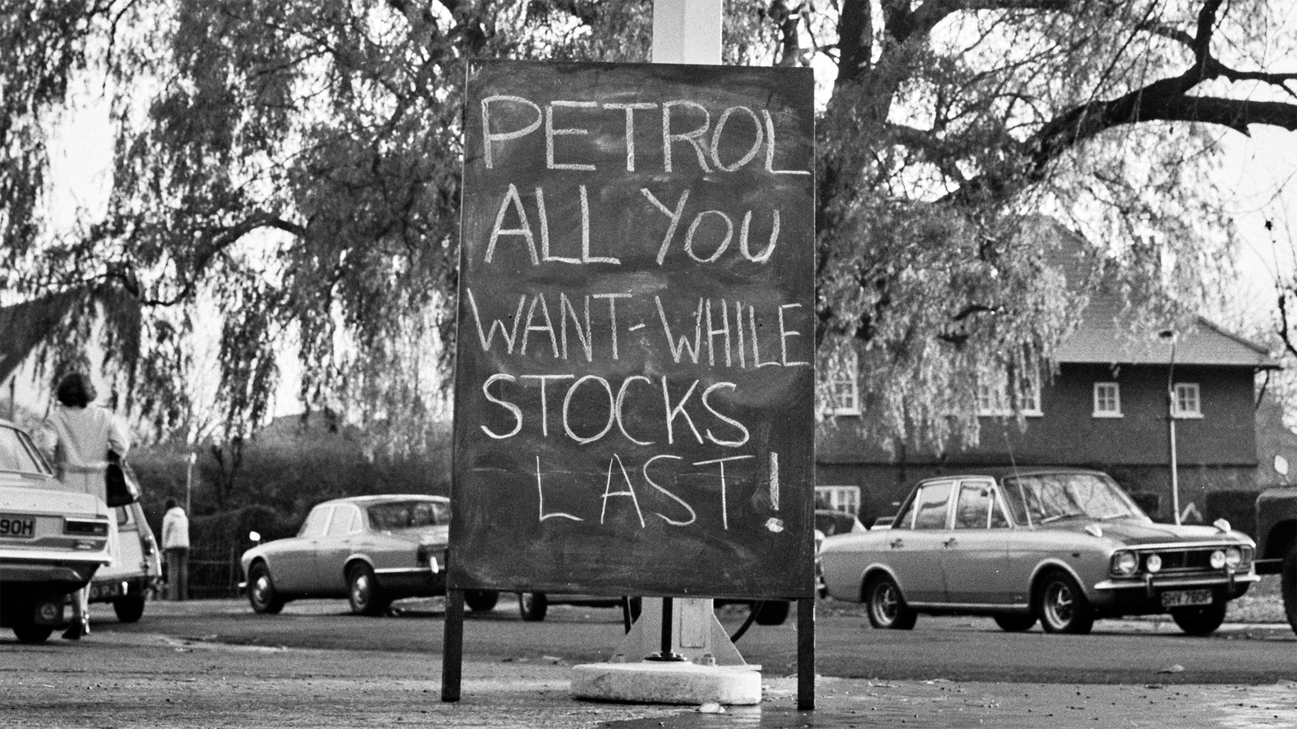
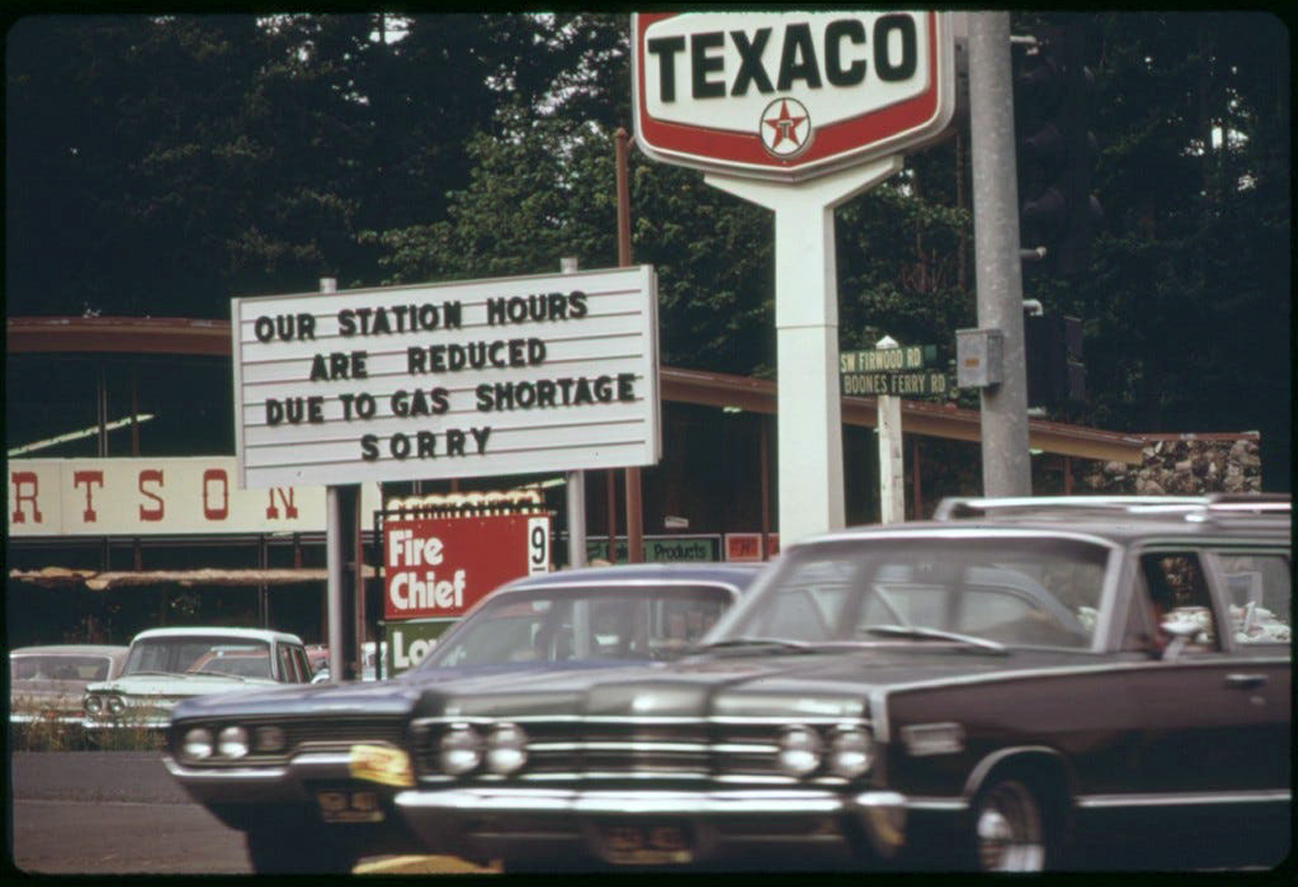
1973 oil crisis
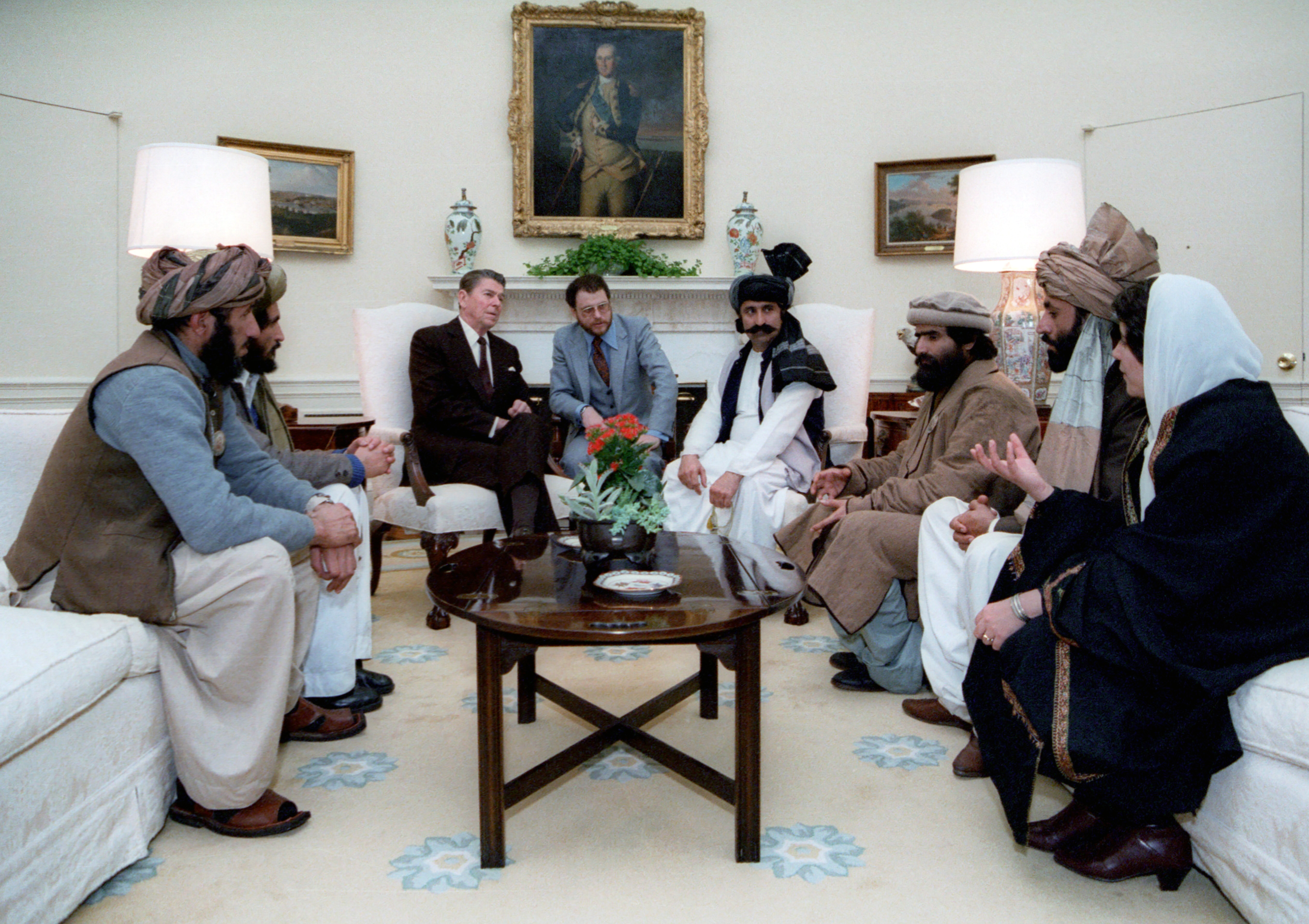
We say “petrol…”…they say “gas”President Reagan meeting with Afghan Mujahideen leaders in the Oval Office in 1983.
Operation Cyclone… Iran–Contra affair… The USA and the UK were funding Afghan mujahideen from 1979 to 1992, prior to and during the military intervention by the USSR in support of the Democratic Republic of Afghanistan. It is now know that the CIA and MI6 were supporting militant Islamic groups, including groups with jihadist ties, that were favored by the regime of Muhammad Zia-ul-Haq in neighboring Pakistan, rather than other, less ideological Afghan resistance groups that had also been fighting the Soviet-oriented Democratic Republic of Afghanistan administration since before the Soviet intervention.
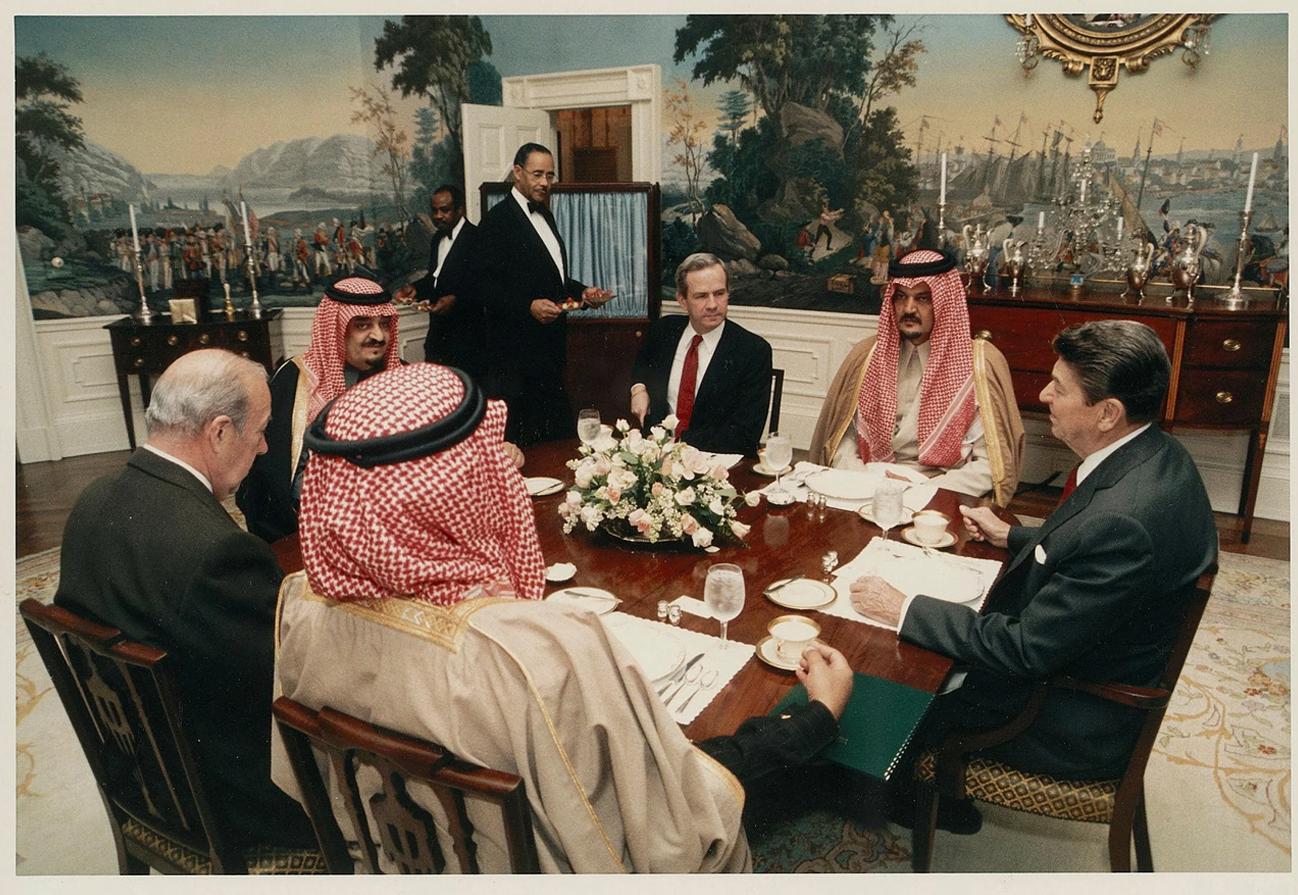
February 12, 1985, President Ronald Reagan has breakfast in the private President’s Dining Room on the Second Floor of the White House with King Fahd ibn ʻAbd al-ʻAzīz of Saudi Arabia.
Ashton, N., & Gibson, B. (2012). The Iran-Iraq War: New International Perspectives. Taylor & Francis Group.
Baker, R. W., Ismael, S. T., & Ismael, T. Y. (2010). Cultural Cleansing in Iraq: Why Museums Were Looted, Libraries Burned and Academics Murdered. Pluto Press.
Basedau, M., & Lay, J. (2009). Resource Curse or Rentier Peace? The Ambiguous Effects of Oil Wealth and Oil Dependence on Violent Conflict. Journal of Peace Research, 46 (6), 757–776. http://jpr.sagepub.com/content/46/6/757.abstract
Basosi, D., Garavini, G., & Trentin, M. (2018). Counter-Shock: The Oil Counter-Revolution of The 1980s. I. B. Tauris.
Beblawi, H., & Luciani, G. (Eds.). (1987). The Rentier State. Croom Helm.
Bini, E., Garavini, G., & Romero, F. (Eds.). (2016). Oil Shock: The 1973 Crisis and Its Economic Legacy. I. B. Tauris.
Bridge, G. (2008). Global production networks and the extractive sector: governing resource-based development. Journal of Economic Geography, 8(3), 389–419. https://doi.org/10.1093/jeg/lbn009
Bronson, R. (2008). Thicker Than Oil: America’s Uneasy Partnership with Saudi Arabia. Oxford University Press.
Little, D. (2017). Shadow Wars: The Secret Struggle for the Middle East. The Middle East Journal, 71(2), 328–330. https://www.jstor.org/stable/90016332
Looney, R. E. (2011). Handbook of Oil Politics. Taylor & Francis.
Losman, D. L. (2010). The Rentier State And National Oil Companies: An Economic And Political Perspective. The Middle East Journal, 64(3), 427–445.
Ross, M. L. (2012). The oil curse: How petroleum wealth shapes the development of nations. Princeton University Press.
Rutledge, E. J. (2017). Oil rent, the Rentier State/Resource Curse narrative and the GCC countries. OPEC Energy Review, 41(2), 145–159. https://doi.org/10.1111/opec.12098
America’s overdependence on foreign credit is no exception to the old adage that too much of a good thing is ultimately bad. It is safe to assume that over the next decade or so, the dollar will depreciate considerably and will no longer be the sole currency used for oil invoicing. Whilst IMF-governed SDRs (special drawing rights) would be the more egalitarian and macro-economically sensible alternative, the more likely is a tripartite reserve and oil invoicing system — dollars for the Americas, euros for Europe and surrounding states and renminbi for much of Asia.
At present, however, a realistic alternative to the dollar has yet to emerge, either as a reserve currency or as a universally acceptable unit in which to settle cross-border trade. At least two-thirds of all central bank reserves are held in dollars, four-fifths of all international trade transactions are settled in dollars and some 45 per cent of global debt is denominated in it. The government-issued euro bond market is less deep and far less liquid than its US counterpart and only recently have the Chinese started to encourage foreign investors to acquire renminbi. Nevertheless a majority of observers contend that the dollar will devalue considerably in the coming decades, either by default or design.
A range of reasons is proffered including the huge US fiscal and current account deficits (net US external debt grew by more than $1.3 trillion in 2008) and the fact that China — in order to enhance domestic consumption and purchasing power — is now gradually beginning to strengthen the renminbi. More fundamentally, and as the recent economic crisis has again highlighted, there is an inherent instability in having a dominant sovereign currency doubling up a global reserve currency. All of this leads to a series of unknowns: what if anything will replace the incumbent petrodollar? And, will the transition be gradual and multilaterally managed? Or will it be sharp and unfold in a mercantilistic haphazard manner?
In the 1960s Yale economist Robert Triffin argued that an international reserve system based on the sovereign currency of the dominant economy would always be unstable.
The Triffin dilemma
Firstly, because the only way for all other economies to accumulate net assets in the dominant currency is for the dominant economy to perpetually run a current account deficit. Secondly, while the dominant economy would be able to detach interest rate decisions from exchange rate implications, all other open economies would be constrained somewhat by the resulting appreciation or depreciation of their currency vis-à-vis the dominant currency.
Such exchange rate uncertainty has, in my view, become far more acute in the decades following the collapse of Bretton Woods. For as international trade increases and becomes an ever greater component of open economy GDP compositions, exchange rate fluctuations and uncertainties have an ever greater impact. Shock transmission — both positive and negative — can now be globally felt pretty much instantaneously thanks to the liberalisation of cross-border capital flows, widespread deregulation of domestic financial markets and advances in telecommunications. The ‘search for yield’ in cross-border currencies tends to result in too much credit creation and in turn, leads to asset/stock price bubbles — in other words a cycle of boom and bust.
With the noted exception of the US, all open market economies essentially have two choices when it comes to exchange rate regimes — neither is optimal, both have associated economic costs.
Two choices
One choice is the ‘free float’, yet this invariably causes uncertainty for both exporters and importers in the given economy and results in its output either being undervalued or overpriced. The other choice is a fixed, managed or crawling peg to the anchor currency. Yet, in order to maintain the peg the given central bank must effectively outsource key monetary policy decisions (in most cases to the Federal Reserve). When the business cycles of the US and the given pegging economy are out of sync, the latter is unable to use interest rates to dampen or foster economic activity; consider the Gulf’s recent era of double-digit inflation.
According to a former French foreign minister, the US has an ‘exorbitant privilege’ in that it is permanently receiving transfers from the rest of the world in the concrete form of seigniorage revenues and also by being able to employ a truly independent monetary policy.
The fact that oil has been priced in and sold in dollars since the foundation of Opec is also highly significant. For if oil, critical to all economies, can only be purchased in dollars, all nations have a strong incentive to accumulate dollars. Indeed it has been argued that the US government effectively prints money (on paper which has virtually no intrinsic value) to purchase the oil, not to mention all the other dollar-denominated commodities, its economy requires.
This state of affairs has been compared to a credit card that attracts customers by offering low interest and deferred payments, and two prominent American economists, Fred Bergstena and Barry Eichengreenb have both recently written in the respected Foreign Affairs journal warning of the problems of this set-up. While neither sees the dollar losing its hegemonic status in the short term, both stress the negative impact of such high levels of debt. A penchant for ‘cheap’ Asian imports has had a detrimental impact on domestic US manufacturing and it is the case that most of the foreign credit funds consumption rather than productive investment. Nevertheless many American officials are happy with the status quo as it enables the average citizen to live beyond his or her means, and government budget deficits to be financed by oil-exporting Middle Eastern countries.
Future scenarios
Even if those who argue that it is in America’s self interest to reduce dependency on foreign credit are dismissed, recent events suggest a gradual dollar de-leveraging process will take place regardless. Indeed, in the absence of another real estate price boom or another ‘0-per-cent finance consumer-fuelled boom’, an export-led recovery is by far the most viable longer term US growth strategy, and a weaker dollar would facilitate this.
Concern over the magnitude of the US’s debt and the evident instability of the current global monetary system, has led many to look for alternatives. Some projections indicate that by 2030, the US will be transferring as much as 7 per cent of its entire annual output to the rest of the world in the form of debt repayments (debt erosion by way of dollar devaluation is a possible response yet this would hurt all of those outside of the US with dollar-denominated assets).
China’s central bank governor, Zhou Xiaochuan, made the headlines earlier this year when he suggested a supra-national currency based on the IMF’s SDRs could eliminate the ‘inherent risks of credit-based sovereign currency’. This cannot simply be discounted as posturing for China has over $800-billion-worth of liquid dollar reserves: Any move by the People’s Republic would have ramifications for all other dollar holders.
The most utopian — yet least likely — future scenario would be the implementation of some form of supranational currency, seigniorage would be equitably distributed and self interest would give way to the collective interest. This would result in a fairer deal for developing economies, as according to José Ocapoc, in order to maintain pegs or insure against capital flight such states have little choice but to transfer resources to the rich industrialised world — a phenomenon that the UN has called ‘reverse aid’.
The concept of a supranational fiat currency is not new, at the very least it dates back to Keynes. He argued that the international community should set up a unit of exchange to act as a reserve currency and even suggested that it be named the Bancor. The IMF’s SDR facility is not too dissimilar and a recent UN commission headed by the economic Nobel laureate Joseph Stiglitz has advocated a greatly expanded role for SDRs. Earlier this year the G20 did agree to create an additional $250 billion in SDRs; taking their share of global reserves from under 1 per cent to about 5 per cent.
Problems with multilateralism
There are of course various problems with multilateralism — mercantilist self interest being a predominant one — one only need consider the recent debacle at the UN’s Climate Change summit at Copenhagen to get an idea of the likely difficulties agreement on a new global form of exchange is likely to be. More practically though, SDRs are not as yet legal tender, nor are they backed by debt markets and for a reserve currency to work a deep and liquid market is deemed essential.
Another possible future scenario would see increased competition between the various emerging currency blocs, tit-for-tat protectionism and the potential for considerable currency and exchange rate instability.
Much of this could arise over the thorny issue of oil invoicing. The petrodollar standard, it has been argued, is the ‘Achilles heel’ of the dollar’s continued hegemonic status. China needs more oil and, going forward will want to purchase some of this with its strengthening renminbi, this entails ending the exclusivity of the petrodollar standard.
If a transition to a tripartite invoicing system were not to take place consensually and gradually, oil could suddenly become very expensive in dollar terms and this would disproportionately impact on American consumers and its economy alike. This alongside the need to transfer income overseas to pay off debt could erode Americans’ standards of living. In different ways both Bergsten and Eichengreen have argued that if the US does not soon begin to address the issue of overdependence on foreign debt, its ability to pursue autonomous economic and foreign policy objectives will become increasingly difficult.
The most likely future scenario is piecemeal and gradual dollar devaluation — this is both in the interests of the US and all of its counterparts. Those with dollar assets do not want to see these lose value too precipitously and neither the Europeans nor the Japanese want their currencies to appreciate any more than they have done so recently. In the longer term the current reserve ratio of 60/30 — dollar/euro will probably recalibrate to 40/40/15 — dollar/euro/renminbi.
In the past decade China has pretty much made all it can out of being the world’s factory and now needs to ‘move up the value chain’. In order to increase household incomes and boost domestic private consumption a stronger renminbi will be needed. This will boost domestic consumption and purchasing power, a stronger currency would make foreign assets cheaper to acquire. It would also turn the renminbi into a potential reserve currency and, at the same time, enable it to take on a more prominent role on the global stage.
Russia’s central bank confirmed in a recent report that it had increased the share of euros in its reserves from around 42 per cent to more than 47 per cent in 2008 and that it intended to further reduce its dollar holdings in the coming period. Its proximity to the Eurozone is no doubt a key rationale, as it seeks to hedge against increasingly expensive euro-denominated imports it is logical to consider holding more euros in reserve, and invoicing the Europeans in euros for their oil needs.
Yet as Stiglitz contends, a move to a dollar-euro duopoly would still result in global imbalances and disadvantage poorer nations who would continue to need to hold large amounts of developed world’s currencies in reserve either in order to maintain exchange rate pegs or in an endeavour to hedge against economic downturns. Similarly, a tripartite reserve system — comprising of dollars, euros and renminbi — while more distributed, would still fall short of a well regulated and suitably tradable supranational fiat currency.
Despite this shortcoming, from the perspective of the GCC, if a tripartite reserve system were to emerge each of the currency blocs would have the strength and thus ability to purchase commodities such as oil in their currency. This would be no bad thing for the Gulf’s oil exporters as it would enable them to build up a more diversified savings portfolio and possibly even pursue a more independent monetary policy.
Bio:
Emilie Rutledge is Assistant Professor of Economics at the United Arab Emirates National University